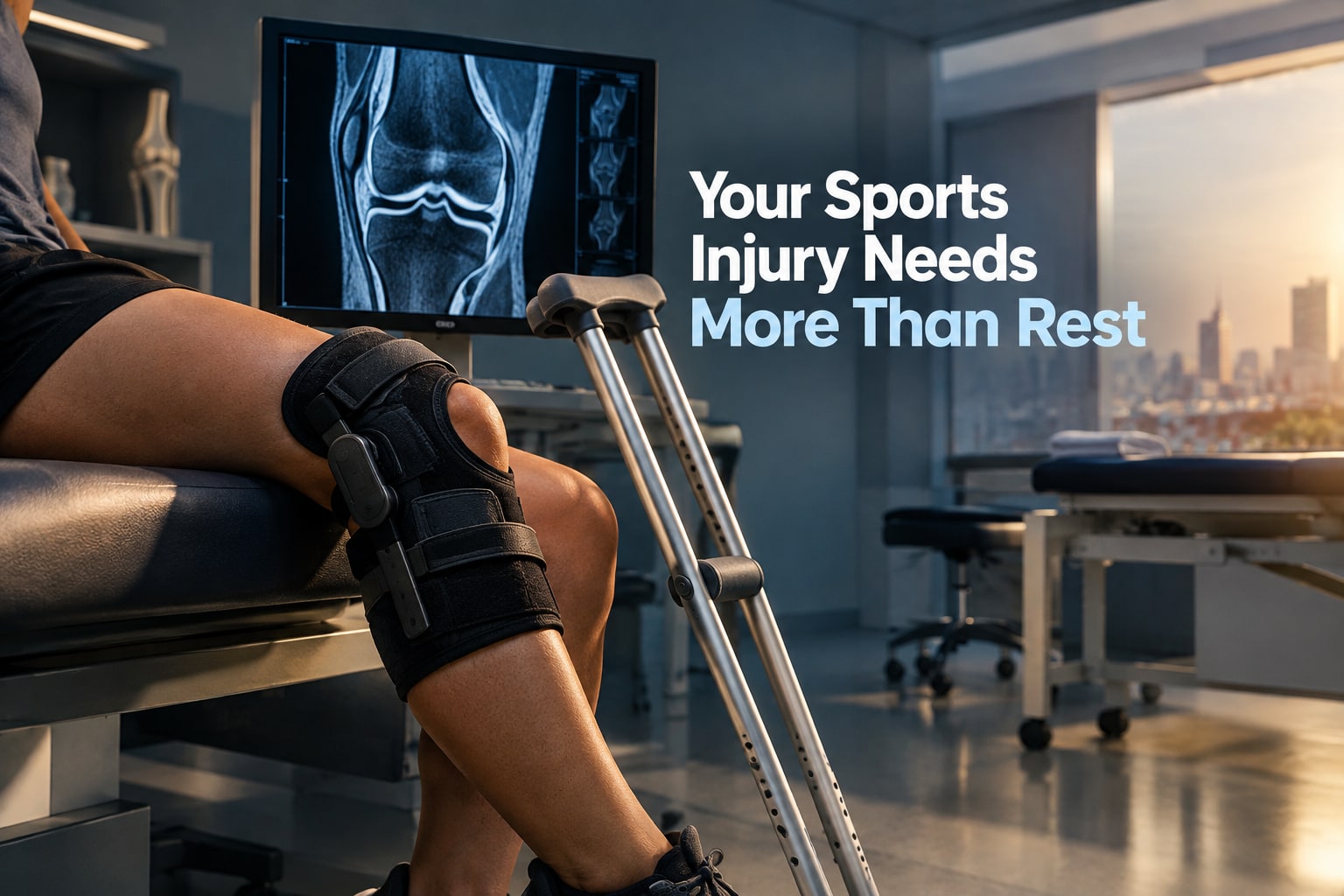
A sports injury needs the right response before it needs a treatment package: continuing to play through a torn ligament is different from managing a mild muscle strain, and a cold, pulseless limb is an emergency. By the end, you will know how to triage the injury, understand the role of each scan, compare treatment pathways, and judge whether a coordinated orthopedic service is useful for your recovery.
Key takeaways
- Seek emergency care for deformity, suspected fracture, or a cold or pulseless limb.
- Treat a shoulder dislocation urgently to reduce nerve, blood-vessel, and cartilage damage.
- Compare rest, rehabilitation, injections, and surgery against your injury and activity goals.
- Return to sport only after strength, movement, and sport-specific control have recovered.
Which sports injuries need immediate care?
A visible deformity, suspected fracture, or a cold or pulseless limb requires emergency assessment, not a routine appointment. Shoulder dislocation emergency care is also urgent because delayed treatment can worsen nerve, blood-vessel and cartilage damage.
Injuries differ in urgency:
| Injury or symptom | Usually routine assessment | Emergency warning |
|---|---|---|
| Ankle sprain | Pain and swelling but you can walk | Inability to bear weight, deformity or rapidly increasing swelling |
| ACL tear or meniscus tear | Instability, swelling or catching after a knee injury | Locked knee, suspected fracture or severe pain out of proportion |
| Muscle strain, tendon problem or tennis elbow | Local pain without major loss of function | Sudden loss of function, marked weakness or deformity |
| Stress fracture | Gradually increasing, activity-related pain | Inability to walk, severe focal pain or swelling after a sudden break |
Stop playing when pain changes your movement. Then:
- Protect the area from further impact and avoid testing it repeatedly.
- Use ice wrapped in cloth for short periods; never place ice directly on skin.
- Apply comfortable compression only while sensation and normal colour remain intact. Loosen it if numbness, tingling or colour change develops.
- Elevate a swollen limb above heart level when practical.
An open wound over a fracture needs wound protection, urgent antibiotics, tetanus assessment, imaging and specialist planning. Do not probe it, wash deeply or close it yourself; cover it with a clean dressing and seek emergency care.
What happens during assessment and imaging?
At a sports injury consultation, the clinician will ask how the injury happened, which sport and position were involved, whether training recently changed, and about prior injuries. Explain when pain appears, what worsens it, and whether the joint gives way, catches or feels unstable.
The examination compares both sides for swelling, tenderness, deformity, movement range, strength, stability, sensation and pulses, then checks sport-specific movement.
The physical assessment may include:
- Walking, squatting, stepping, landing or another movement that reproduces your sport’s demands.
- A comparison of the injured and uninjured limb, because a small difference in motion or strength can guide the diagnosis.
- Checks for urgent circulation or nerve problems, especially after a dislocation or suspected fracture.
| Test | Answers | Important limit |
|---|---|---|
| X-ray | Shows alignment, dislocation and many fractures | A normal X-ray does not exclude an ACL tear, meniscus tear, cartilage injury or an occult nondisplaced fracture. |
| Ultrasound | Assesses accessible tendons, muscle tears, fluid and movement while the area moves | It cannot provide MRI-level views of deep ligaments or menisci. |
| MRI | Best for ACL, meniscal, cartilage, tendon and bone-marrow injuries; useful for an MRI knee injury assessment | It is not automatically needed for every painful knee. |
| CT | Provides detailed views of complex or subtle fractures and surgical bone anatomy | It does not replace MRI for most ligament or meniscus questions. |
For an acute knee injury with suspected fracture, an X-ray is usually the first scan. The examination determines whether you need further imaging rather than ordering an MRI automatically.
How are treatment options compared?
Rest, rehabilitation, medication, an injection, or surgery is chosen by matching the treatment to tissue damage, instability, work and sport demands, symptoms, and your capacity to complete rehabilitation.
| Option | What it means | When it applies |
|---|---|---|
| Rest and activity modification | Reduce loading while keeping safe movement | Strains, many tendon problems, and selected ACL injuries |
| Brace, pain relief and physiotherapy for sports injuries | Support the joint, control symptoms and rebuild strength | When instability is limited and function improves without surgery |
| Injection | Temporarily reduce pain or inflammation | Selected persistent joint symptoms; it does not repair a torn structure |
| ACL reconstruction | Rebuild the torn ligament | Consider it when instability persists, your sport involves repeated pivoting, or a repairable associated injury exists |
| Surgery or meniscus surgery | Repair or remove damaged tissue | A displaced or repairable traumatic tear, or true mechanical locking; not an MRI abnormality alone |
After an ACL tear, preoperative rehabilitation can restore motion and reduce swelling before ACL reconstruction. Most meniscal tears do not require arthroscopy. A degenerative tear differs from a displaced traumatic tear, and exercise-based care usually comes first.
Discuss arthroscopy risks before choosing it: infection, bleeding, blood clots, stiffness, nerve or blood-vessel injury, and persistent symptoms. Compare recovery time, cost, rehabilitation effort, and uncertainty about returning to sport.
For persistent knee or hip osteoarthritis, strengthening and weight management remain core care. Injections and joint replacement do not replace rehabilitation; surgery is considered when pain and loss of function remain substantial despite appropriate non-surgical treatment.
When does one-location orthopedic care help?
One location helps when assessment, sports injury radiology, fracture and trauma care, surgery, and physiotherapy share information instead of sending you between disconnected services. An orthopedic sports injury clinic Pune patients choose should make follow-up easier, not merely offer the same address for every appointment.
Before choosing a service, ask:
- Who reviews the images, and do the radiologist and surgeon discuss difficult findings?
- How are urgent fractures and dislocations transferred?
- Does physiotherapy use the same treatment goals and milestones as the orthopedic team?
- What happens after hours, who contacts you with results, and which symptoms require an emergency department?
- Will the team explain whether your symptoms match the examination and scan findings?
For Dr Aniruddha Deshmukh-Orthopedic Doctor, Joint Replacement & Arthroscopy Surgeon in Hinjewadi, Pune, these questions help you assess coordination rather than assume it from the clinic name.
| Care setting | What it should provide | When it applies |
|---|---|---|
| Connected orthopedic service | Linked assessment, imaging review, surgery and rehabilitation | Routine follow-up when teams communicate |
| Separate providers | You confirm that reports, prescriptions and rehabilitation goals reach each clinician | When location or specialist choice matters more than convenience |
| Emergency department | Immediate assessment, vascular checks and urgent fracture or dislocation management | Deformity, suspected fracture, cold or pulseless limb, rapidly increasing swelling, or severe pain out of proportion |
A single address does not prove diagnostic accuracy or surgical quality. Seek an orthopedic second opinion when surgery lacks a clear structural or mechanical reason, or when the imaging report does not match your symptoms.
Related services
Sports Injury Management Sports Injury Management in Hinjewadi, Pune Dr. Aniruddha Deshmukh is a trusted orthopedic doctor specializing in Sports Injury Management in Hinjewadi, Marunji and Pune, providing... View service → |
Sports Injury Management Sports Injury Management in Wakad, Pune Dr. Aniruddha Deshmukh is a trusted orthopedic doctor specializing in Sports Injury Management in Wakad, Pimple Nilakh, Thergaon and Pune, providing... View service → |
How do you return to sport without repeating the injury?
A fixed number of rest days cannot decide when you are ready to compete. Recovery is judged by function, symptoms and sport demands, not the calendar.
An acute traumatic injury follows a single event. An overuse injury develops when training load exceeds tissue recovery, while a recurrent injury often points to poor technique, inadequate strength, restricted mobility or an incomplete sports injury rehabilitation programme.
Use these return to play criteria before increasing competition:
- Pain-free movement through the required joint range
- Near-symmetrical strength compared with the uninjured side
- Stable balance and controlled single-leg or whole-body movements
- Confidence performing the task without guarding or fear
- Successful sport-specific drills, including landing, cutting, sprinting, throwing or contact practice
Increase training load in stages: rehabilitation exercises, partial practice, full practice and then competition. Track pain during activity, swelling later that day and next-day function. A flare-up means the previous step was too demanding; jumping from rest to full competition raises reinjury risk and undermines injury prevention.
ACL recovery after reconstruction requires strength, movement quality, psychological readiness and progressive sport exposure, not elapsed time alone. Surgery cannot guarantee your previous performance level or prevent later knee osteoarthritis.
After any major operation, seek prompt medical review for persistent wound drainage, fever, increasing redness, calf swelling, chest pain, breathlessness or sudden loss of function. These symptoms can signal infection, thrombosis, pulmonary embolism or an implant-related problem.
Frequently asked questions
Which sports injuries need immediate care?
Seek emergency assessment for a visible deformity, suspected fracture, or a limb that is cold or pulseless. A shoulder dislocation also needs urgent care because delay can increase nerve, blood-vessel, and cartilage damage.
What happens during sports injury assessment and imaging?
The clinician checks the injury mechanism, pain, swelling, movement, strength, sensation, circulation, and joint stability. Imaging may include an X-ray for suspected fracture or dislocation, while MRI or ultrasound helps assess ligaments, tendons, cartilage, and muscle.
How are sports injury treatment options compared?
Treatment is compared by the structure injured, tear or fracture severity, joint stability, symptoms, activity demands, recovery time, and risks. Options can include protection and rehabilitation, medication, injections, or surgery.
When does one-location orthopedic care help?
One-location care helps when assessment, imaging review, treatment planning, orthopedic procedures, and rehabilitation coordination need to stay connected. It reduces repeated explanations and makes follow-up easier.
How do you return to sport without repeating the injury?
Progress from pain-controlled movement to strength, balance, agility, and sport-specific drills. Return after the injured side has regained adequate movement, strength, control, and confidence rather than relying only on reduced pain.
Related services
Sports Injury Management Sports Injury Management in Baner, Balewadi, Pune Dr. Aniruddha Deshmukh is a trusted orthopedic doctor specializing in Sports Injury Management in Baner, Balewadi, and Pune, providing comprehensive... View service → |
Sports Injury Management Sports Injury Management in Mahalunge, Pune Dr. Aniruddha Deshmukh is a trusted orthopedic doctor specializing in Sports Injury Management in Mahalunge, Sus, Pashan and Pune, providing... View service → |
Sports Injury Management Sports Injury Management in Punawale, Pune Dr. Aniruddha Deshmukh is a trusted orthopedic doctor specializing in Sports Injury Management in Punawale and Pune, providing comprehensive care for... View service → |
Sports Injury Management Sports Injury Management in Pimple Saudagar, Pune Dr. Aniruddha Deshmukh is a trusted orthopedic doctor specializing in Sports Injury Management in Pimple Saudagar, Pimple Gurav, Rahatani and Pune,... |