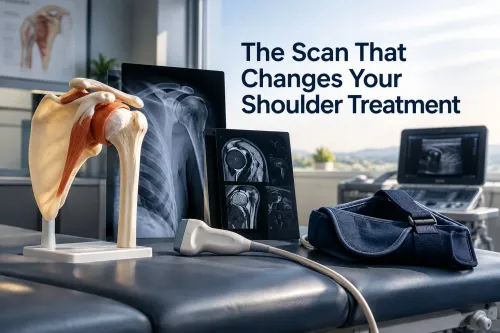
A stiff shoulder is a symptom, not a diagnosis, and the right specialist depends on whether the problem is a tight joint capsule, arthritis, tendon failure, fracture, inflammation or infection. By the end, you will know which assessment to seek, when physiotherapy or arthroscopy fits, and when a joint replacement consultation in Pimple Saudagar is justified.
Key takeaways
- Start with a shoulder specialist for restricted movement, instability, cuff disease, or fracture.
- Seek urgent care after injury, visible deformity, fever, severe pain, or sudden weakness.
- Expect movement tests, strength checks, imaging review, and questions about symptom onset.
- Choose replacement assessment when arthritis causes persistent pain and major loss of function.
Which specialist should assess a stiff shoulder first?
Stiffness alone does not choose the specialist; the cause does. A shoulder-and-elbow surgeon is usually the most direct first choice for restricted motion, instability, rotator-cuff disease, or a shoulder fracture. A general orthopedic surgeon can assess the same problem and refer you when the diagnosis requires narrower expertise.
| Specialist | Main focus | When it fits a stiff shoulder |
|---|---|---|
| Shoulder surgeon | Shoulder and elbow conditions, including arthritis, fractures, instability, and cuff disease | When examination and imaging point to a shoulder-specific problem |
| Arthroscopy surgeon | Keyhole procedures, such as capsular release or rotator-cuff repair | When persistent stiffness or a confirmed tendon problem may need arthroscopy |
| Joint replacement surgeon | Anatomic and reverse shoulder replacement | When X-rays show advanced glenohumeral arthritis, selected fractures, or cuff-tear arthropathy |
| General orthopedic surgeon | Broad bone, joint, muscle, and injury care | When the diagnosis is unclear or several musculoskeletal problems overlap |
An arthroscopy surgeon in Pimple Saudagar is not automatically the right choice simply because the shoulder feels severely locked. Adhesive capsulitis, or frozen shoulder, often follows painful, freezing, and thawing phases and is not usually treated with replacement. Conversely, modest pain with advanced cartilage loss can justify a joint replacement surgeon.
Ask what diagnosis is confirmed, which movements are restricted, what the X-rays show, and what rehabilitation has already been tried. Compare procedure volume for your specific condition, not just the surgeon’s title.
What the stiffness pattern can reveal—and when it is urgent
Stiffness with pain during nearly every movement, especially reduced external rotation and difficulty reaching overhead or behind your back, points toward adhesive capsulitis, also called frozen shoulder. It often develops without a clear injury and restricts both your active and passive range of motion.
Glenohumeral osteoarthritis causes deeper joint pain, grinding, reduced external rotation and stiffness that worsens with use. Night pain with weakness suggests rotator-cuff disease; advanced rotator-cuff tear arthropathy can combine weakness, painful overhead movement and loss of smooth shoulder motion.
Previous fracture, dislocation or prolonged immobilisation can leave a mechanical restriction, while rheumatoid arthritis can cause swelling, warmth and stiffness in more than one joint.
Use these warning signs to seek urgent medical assessment instead of arranging an elective specialist search:
- Fever with a red, hot, swollen shoulder, rapidly worsening pain or inability to move the arm, especially after surgery, an injection, a penetrating wound or a recent bloodstream infection
- A fall or blow followed by visible deformity, severe swelling, sudden loss of movement or severe pain
- Numbness, new marked weakness, or a hand that becomes cold, pale or bluish
- Sudden inability to use the arm after an injury
A stiff shoulder alone is not an emergency, but these patterns can signal infection, fracture, dislocation or nerve and blood-vessel injury. The cause—not simply how severe the stiffness feels—determines whether you need a shoulder-and-elbow, arthroscopy or joint replacement specialist.
What happens during the first shoulder assessment?
The assessment starts with your timeline: injury, gradual stiffness, night pain, fever, swelling, diabetes, rheumatoid arthritis, previous surgery, and treatments already tried. The examiner records active range of motion as you lift and rotate the arm yourself, then tests passive range of motion while supporting it.
- Strength examination checks the rotator cuff with resisted lifting and rotation, while also looking for nerve-related weakness.
- A shoulder X-ray looks for arthritis, fracture, dislocation, reduced joint space, bone loss, or an abnormal joint shape.
- Ultrasound can assess rotator-cuff tendons dynamically and without radiation.
- A shoulder MRI is useful for tendon tears, labral injury, cartilage damage, marrow changes, or infection when the examination and X-ray do not explain the problem.
- CT gives a more detailed view of fracture fragments, bone deformity, or severe arthritis before complex surgery.
- Blood tests such as a complete blood count, C-reactive protein, erythrocyte sedimentation rate, or rheumatoid factor are selective, not automatic.
The movement pattern changes the suspected diagnosis. If both active and passive motion are substantially limited, a tight joint capsule, adhesive capsulitis, arthritis, or fracture-related stiffness becomes more likely. If active motion is far worse than passive motion, the joint may move when assisted, pointing instead toward rotator-cuff failure, pain inhibition, or nerve disease.
A normal X-ray does not rule out tendon or nerve problems.
When do physiotherapy, injections or arthroscopy make sense?
Nonsurgical care makes sense when the diagnosis is treatable without changing the joint, and when you can complete a consistent rehabilitation plan. Shoulder physiotherapy usually means supervised sessions plus daily home exercises for several weeks to months; stopping when pain eases often leaves the stiffness unchanged. Activity modification and suitable pain relief support the programme.
Frozen shoulder follows painful, freezing and thawing phases. Pain dominates early, movement progressively tightens during freezing, and motion gradually returns during thawing. Recovery can take 1 to 3 years, so uncomplicated frozen shoulder is not usually a reason for shoulder replacement.
A corticosteroid injection can reduce early pain and make exercises easier, but it does not restore a damaged joint or replace rehabilitation.
Arthroscopy is considered when passive movement remains restricted after a properly supervised programme, the diagnosis supports intervention, and the risks of anaesthesia and surgery are acceptable. The procedure depends on the problem:
| Procedure | Main purpose | When it fits |
|---|---|---|
| Capsular release | Cuts contracted joint capsule | Persistent adhesive capsulitis with severe passive stiffness |
| Rotator-cuff repair | Reattaches a repairable torn tendon | Painful weakness from a repairable cuff tear |
| Joint replacement | Replaces damaged joint surfaces | Advanced arthritis with lasting pain and disability despite appropriate care |
Ask what the X-rays show, how long nonsurgical treatment has been tried, and why arthroscopy or replacement is preferable to continued rehabilitation.
When is a joint replacement surgeon the better choice in Pimple Saudagar?
A replacement consultation is justified when X-rays show advanced glenohumeral arthritis, pain persists despite appropriate rehabilitation, or a selected proximal humerus fracture cannot be reliably treated with fixation. It also fits cuff-tear arthropathy: an irreparable rotator-cuff tear combined with painful loss of shoulder function.
Not every fracture needs shoulder replacement; displacement, bone quality, age, activity, fracture pattern and cuff condition determine the choice.
| Option | What it means | When it applies |
|---|---|---|
| Anatomic total shoulder replacement | Replaces the damaged ball and socket while preserving normal mechanics | Arthritis with a functioning rotator cuff |
| Reverse shoulder replacement | Reverses the ball-and-socket arrangement so the deltoid can raise the arm without a working cuff | Cuff-tear arthropathy or an irreparable cuff tear with major functional loss |
Shoulder replacement recovery requires early motion exercises, followed by progressive strengthening. Useful function commonly returns over several months, while final improvement can continue for a year or longer. Discuss infection, bleeding, nerve or vessel injury, dislocation, stiffness, loosening, wear, fracture around the implant and revision surgery.
Before choosing care in Pimple Saudagar, ask:
- What confirmed diagnosis do the X-rays show, and which movements are restricted?
- What nonsurgical treatment was tried, and for how long?
- Why is replacement preferable to continued rehabilitation, injection or arthroscopy?
- Which implant and procedure do you recommend, and how many diagnosis-specific operations do you perform?
- What restrictions, physiotherapy schedule and warning signs apply after surgery?
When consulting Dr Aniruddha Deshmukh-Orthopedic Doctor, Joint Replacement & Arthroscopy Surgeon in Hinjewadi, Pune, take your X-rays and prior treatment records so the recommendation addresses documented damage rather than stiffness alone.
Related services
Joint Replacement Surgeon Joint Replacement Surgeon in Pimple Saudagar, Pune Dr. Aniruddha Deshmukh – Leading Joint Replacement Surgeon in Pimple Saudagar, Pimple Gurav, Rahatani and Pune. |
Hip Replacement Surgeon Hip Replacement Surgeon in Pimple Saudagar, Pune Dr. Aniruddha Deshmukh – Trusted Hip Replacement Surgeon in Pimple Saudagar, Pimple Gurav, Rahatani and Pune. Dr. |
Frequently asked questions
Which specialist should assess a stiff shoulder first?
See a shoulder-and-elbow surgeon for restricted motion, instability, rotator-cuff disease, or a shoulder fracture. A general orthopedic surgeon can assess you and refer you when narrower expertise is needed.
When is a stiff shoulder urgent?
Seek prompt medical assessment after an injury with deformity, sudden weakness, severe pain, fever, redness, or an inability to move the arm.
What happens during the first shoulder assessment?
The surgeon reviews when symptoms began, examines active and passive movement, tests strength and stability, and checks X-rays or orders imaging when needed.
When do physiotherapy, injections, or arthroscopy make sense?
Physiotherapy suits many movement and strength problems, injections can help selected painful inflammatory conditions, and arthroscopy is considered for problems such as some cuff tears, instability, or mechanical damage.
When is a joint replacement surgeon the better choice in Pimple Saudagar?
Choose a joint replacement assessment when advanced shoulder arthritis causes persistent pain, stiffness, and reduced function despite appropriate non-surgical treatment.
Related service
Knee Replacement Surgeon Knee Replacement Surgeon in Pimple Saudagar, Pune Dr. Aniruddha Deshmukh – Leading Knee Replacement Surgeon in Pimple Saudagar, Pimple Gurav, Rahatani and Pune. Dr. |