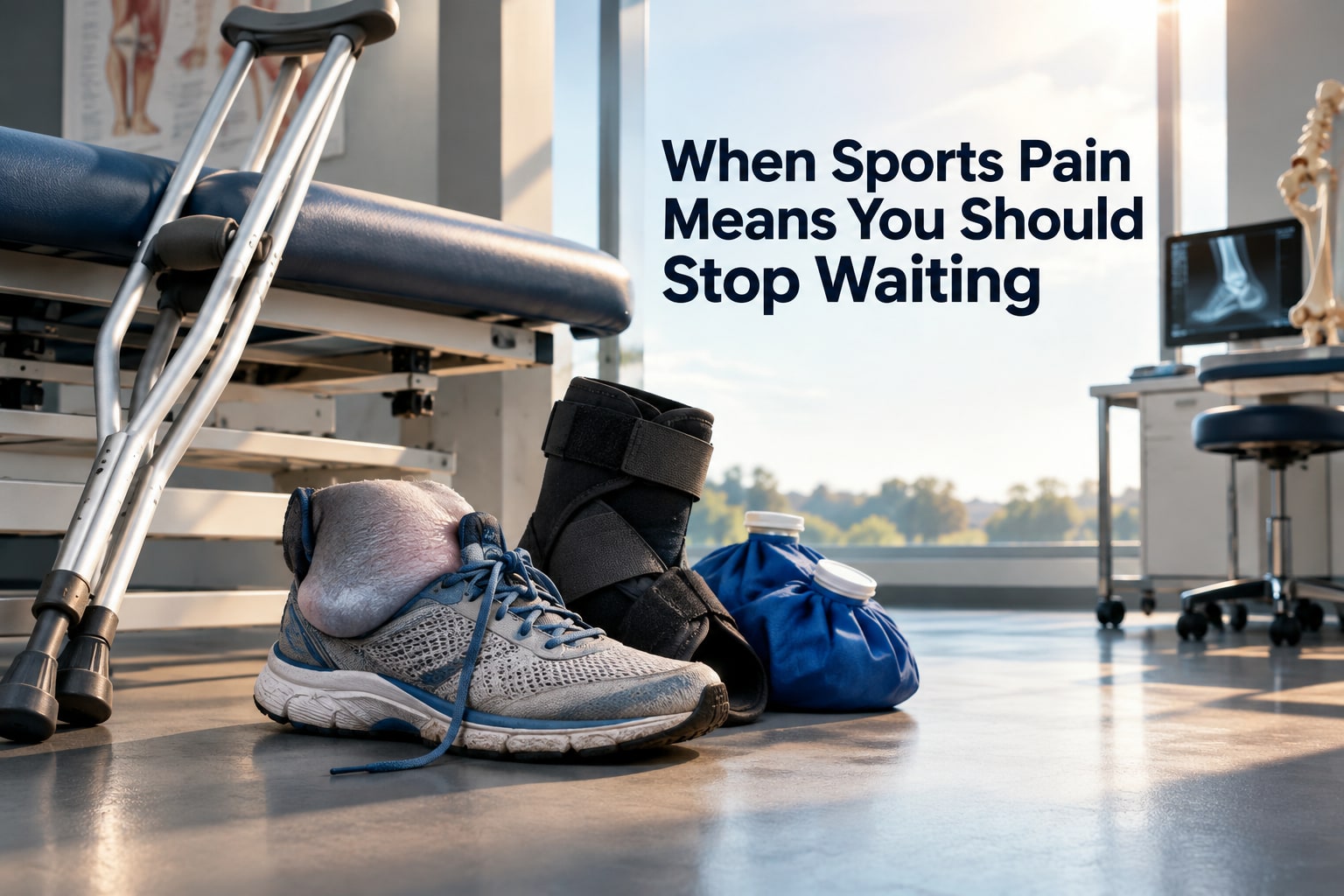
A twisted ankle, painful knee, or sore shoulder is not always a simple strain that improves with rest. By checking emergency warning signs, symptom patterns, recovery time, and changes in movement, you can decide whether you need hospital care, a sports injury specialist, physiotherapy, or short-term home care.
Key takeaways
- Seek emergency care for deformity, loss of sensation, cold skin, or unconsciousness.
- Book an appointment if pain, swelling, or limited movement persists beyond 48 hours.
- Recurring pain or altered movement needs assessment, even when symptoms improve.
- Return to play only after pain-free movement and sport-specific activity.
Which sports injuries need emergency hospital care now?
A sports injury emergency needs immediate hospital care when the injury threatens blood supply, skin, nerve function, or consciousness. Stop play, keep the person still, and call emergency services or go to the nearest emergency department for:
- An obvious deformity, suspected dislocation, or fracture dislocation
- An open wound over a suspected fracture or bleeding that will not stop with firm pressure
- No pulse below the injury, or a limb that becomes cold, pale, blue, numb, or weak
- New loss of movement, rapidly worsening severe pain, or inability to use the limb after major trauma
| Finding | What it may indicate | Correct action |
|---|---|---|
| Stable pain or swelling without warning signs | Injury suitable for a sports injury appointment | Stop play and arrange assessment |
| Shoulder looks out of place | Possible shoulder dislocation | Support it and seek hospital care; never force it back |
| Head injury with vomiting or confusion | Suspected concussion or more serious brain injury | Immediate hospital assessment |
After a head injury, stop play immediately and do not return the same day. Seek immediate care for repeated vomiting, a worsening headache, confusion, unusual drowsiness, seizure, slurred speech, weakness, or unequal pupils.
A shoulder that appears displaced must not be manipulated. Reduction and post-reduction imaging are clinical procedures because forced repositioning can damage nerves, blood vessels, cartilage, or bone. If you are searching for shoulder dislocation Wakad care, treat the visible deformity as an emergency rather than waiting for a routine clinic appointment.
How long should you wait before booking an appointment?
Book an appointment based on function and progress, not pain alone. Major trauma needs urgent assessment, while a minor injury that is clearly improving can receive brief home care first.
1. Seek urgent assessment after major trauma, or when an ankle injury prevents you from taking four steps. The Ottawa Ankle Rules also call for ankle or foot X-rays when tenderness sits at either ankle bone, the base of the fifth metatarsal, or the navicular.
2. Arrange a sports injury specialist appointment if pain, swelling, bruising, or restricted movement is not clearly improving after 48 to 72 hours of sensible protection and relative rest.
Rapid knee swelling within a few hours of a twist deserves prompt review even if you can walk, because bleeding inside the joint can accompany an ACL rupture, kneecap dislocation, or fracture.
3. Book an assessment when symptoms remain after one to two weeks, or when they repeatedly return. A persistent ankle sprain with pain, swelling, instability, or reduced function lasting several weeks is not a series of new sprains; it can indicate ligament, tendon, cartilage, or another injury requiring reassessment.
Do not keep testing a failing joint through sport. Persistent knee locking, giving-way, or inability to straighten also warrants review, especially when the initial pain has settled but normal movement has not returned.
Does the symptom look like soreness, a sprain, or a deeper injury?
Aching that peaks 24–72 hours after unfamiliar exercise, affects several muscles, and eases as you move is more consistent with delayed-onset muscle soreness than structural damage. A minor sprain usually follows a twist, with local tenderness and swelling that steadily improves. Use this comparison:
| Pattern | More consistent with | What to do |
|---|---|---|
| Diffuse muscle ache after training | Ordinary soreness | Reduce load and monitor improvement |
| Local pain after a twist, with improving swelling and movement | Minor sprain | Protect it and arrange assessment if progress stops |
| Locking, giving-way, inability to straighten, focal bone pain, or major weakness | Deeper injury | Stop sport and seek clinical assessment |
Knee locking, recurrent giving-way, or inability to straighten can indicate an ACL injury symptoms pattern, a meniscus tear, loose body, ligament injury, or fracture. Rapid swelling within a few hours of twisting also deserves prompt review, even if you can walk.
A sudden ankle pop with bruising, swelling, and inability to push off or stand on tiptoe suggests Achilles tendon rupture. Sharply localized pain over a bone that worsens with impact can indicate a stress fracture, even when an early X-ray is normal.
Shoulder weakness or painful overhead movement fits a possible rotator cuff injury. Outer-elbow pain can be tennis elbow; wrist pain after a fall or racquet impact needs assessment if movement or grip is limited. Groin or hip pain that changes your stride, and lower-back pain with leg symptoms or altered mechanics, are not ordinary soreness.
A sudden pop, focal bone pain, substantial weakness, or loss of function deserves assessment even when pain later settles.
Why recurring pain or movement changes deserve specialist assessment
Pain that returns with training deserves assessment because repeated loading can expose a torn ligament, meniscus problem, tendon injury, stress fracture, or joint instability. Book an appointment when a joint gives way, painful clicking or locking occurs, swelling keeps returning, or you change your stride, landing, grip, or throwing motion to avoid pain.
| Clinician | Best role | When to choose |
|---|---|---|
| Emergency department | Treat immediate danger | Deformity, suspected dislocation, severe weakness, a cold or numb limb, or rapidly worsening pain |
| General practitioner | Initial evaluation and referral | Symptoms are unclear or you need coordinated medical care |
| Physiotherapist | Build a rehabilitation plan | The diagnosis is suitable for exercise-based recovery |
| Sports injury specialist Wakad | Confirm diagnosis and treatment options | Instability, mechanical symptoms, suspected internal damage, imaging decisions, or surgery questions |
X-rays target suspected fracture or dislocation; they do not show most ligament or meniscus injuries. MRI is usually reserved for persistent symptoms, suspected internal derangement, or a question where the result will change treatment. A normal first X-ray does not exclude a stress fracture if sharply localized bone pain continues with impact.
Surgery is not automatic for a ligament or meniscus injury. The injury pattern, instability, sport demands, associated damage, and response to structured physiotherapy guide that decision.
Dr Aniruddha Deshmukh-Orthopedic Doctor, Joint Replacement & Arthroscopy Surgeon in Hinjewadi, Pune can help Wakad-area patients decide whether examination, imaging, rehabilitation, or further orthopedic treatment fits the findings.
Related services
Sports Injury Management Sports Injury Management in Wakad, Pune Dr. Aniruddha Deshmukh is a trusted orthopedic doctor specializing in Sports Injury Management in Wakad, Pimple Nilakh, Thergaon and Pune, providing... View service → |
Sports Injury Management Sports Injury Management in Baner, Balewadi, Pune Dr. Aniruddha Deshmukh is a trusted orthopedic doctor specializing in Sports Injury Management in Baner, Balewadi, and Pune, providing comprehensive... View service → |
What should you do before the appointment, and when can you return to play?
Stop the activity that provokes symptoms and protect the injured area. Sports injury first aid should reduce further damage, not test your limits.
- Use an ice pack wrapped in a thin towel for 15–20 minutes at a time; never place ice directly on skin. This is safer ice for sports injury swelling.
- Apply comfortable compression if the area is not numb and the skin is not pale, blue, or unusually cold. Loosen it immediately if colour or sensation changes.
- Elevate an injured arm or leg above heart level when practical.
- Record the exact movement or contact, any pop, when swelling began, and what you cannot do now, such as walking, gripping, bending, or lifting.
- Do not massage the area, force a stretch, manipulate a joint, or repeatedly test strength when a fracture, dislocation, major tendon injury, or significant tear is possible.
Set a lower threshold for assessment if you take anticoagulants or have diabetes, osteoporosis, immunosuppression, or a joint replacement. These conditions increase the consequences of bleeding, infection, fracture, or delayed healing.
Return to play after injury only when normal walking and sport-specific movements are pain-free, swelling has settled, and strength and range of motion match the uninjured side. A clinician should clear concerning injuries before you resume; sports injury precautions are not a substitute for examination.
Frequently asked questions
Which sports injuries need emergency hospital care now?
Stop play and seek emergency care for a visible deformity, uncontrolled bleeding, an open fracture, loss of consciousness, a limb that becomes cold or pale, new numbness or weakness, or severe pain after a major impact.
How long should you wait before booking a sports injury appointment?
Book an appointment when pain, swelling, bruising, or restricted movement is not clearly improving within 48 hours, or sooner if you cannot bear weight or use the injured body part normally.
How can you tell soreness from a sprain or deeper injury?
Soreness usually follows a hard workout and improves with rest. A sprain causes pain around a ligament with swelling or instability. Severe pain, a pop, marked swelling, weakness, or persistent loss of movement needs specialist assessment.
Why does recurring pain or a change in movement deserve specialist assessment?
Repeated pain can indicate an untreated ligament, tendon, cartilage, bone, or joint problem. Compensating with a limp or altered technique can shift stress to other areas.
What should you do before the appointment, and when can you return to play?
Stop the activity, protect the area, use a wrapped ice pack for short periods, and avoid massage or forced stretching early after an injury. Return only when you have pain-free movement, near-normal strength, and can perform sport-specific drills without symptoms.
Related services
Sports Injury Management Sports Injury Management in Mahalunge, Pune Dr. Aniruddha Deshmukh is a trusted orthopedic doctor specializing in Sports Injury Management in Mahalunge, Sus, Pashan and Pune, providing... View service → |
Shoulder and Elbow Pain Treatment Shoulder and Elbow Pain Treatment in Wakad, Pune Dr. Aniruddha Deshmukh is a trusted Fracture and Trauma Care Specialist in Wakad, Pimple Nilakh, Thergaon and Pune, providing comprehensive... View service → |
Sports Injury Management Sports Injury Management in Hinjewadi, Pune Dr. Aniruddha Deshmukh is a trusted orthopedic doctor specializing in Sports Injury Management in Hinjewadi, Marunji and Pune, providing... View service → |
Orthopedic Surgeon Orthopedic Surgeon in Wakad, Pune Dr. Aniruddha Deshmukh – Trusted Orthopedic Surgeon in Wakad, Pimple Nilakh, Thergaon and Pune. Dr. |