Choosing a robotic knee replacement surgeon involves more than finding a clinic with a robot. You need to confirm that surgery is appropriate, understand what the technology changes, compare the surgeon and hospital, and plan follow-up close enough for safe recovery.
Key takeaways
- The robot guides planning and bone preparation; the surgeon controls the operation.
- Confirm whether arthritis severity and ligament condition suit robotic knee replacement.
- Compare surgeon experience, hospital facilities, implant options, and follow-up access.
- Bring scans, medication details, medical history, and your recovery goals to consultation.
What robotic knee replacement actually changes
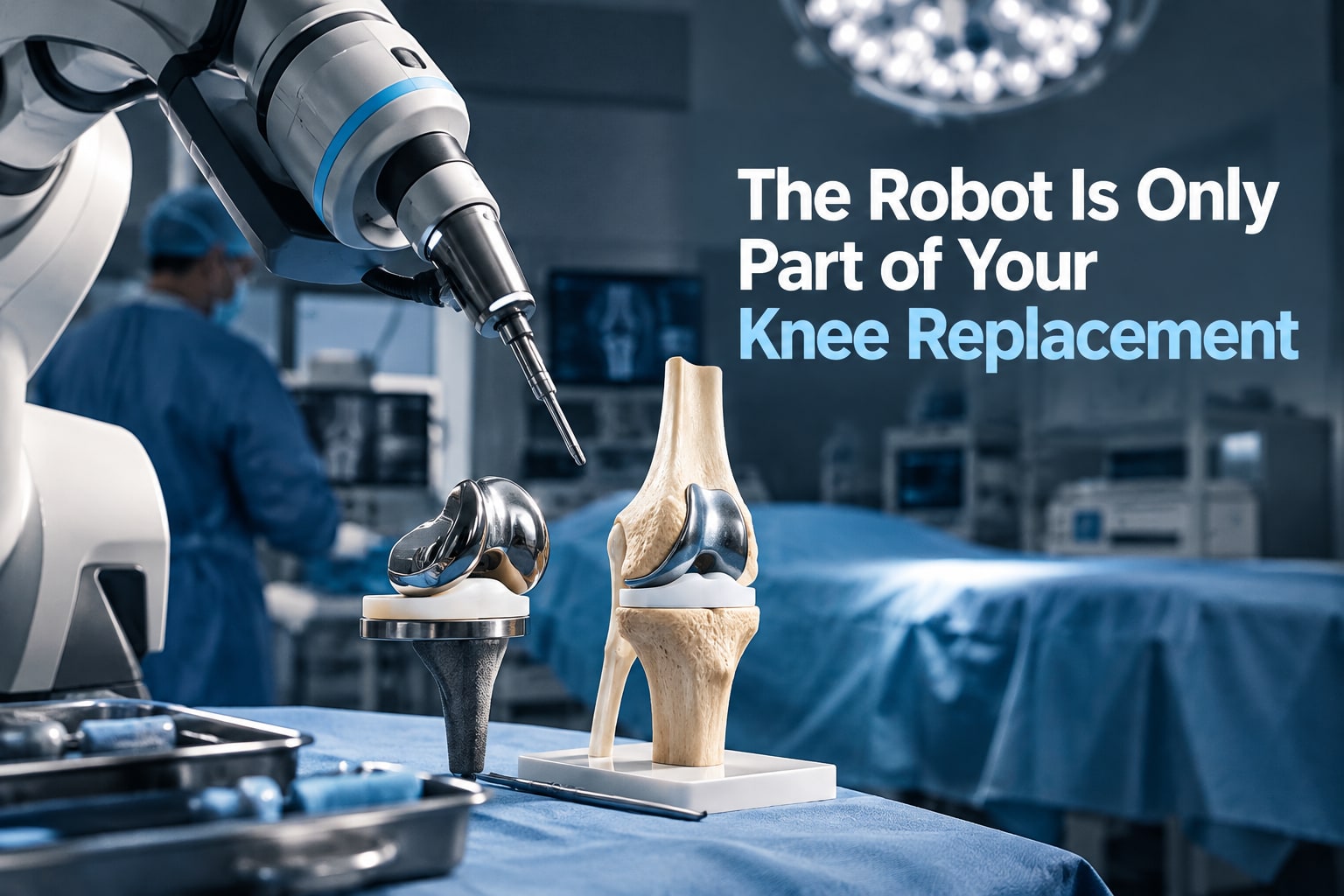
The robot helps the surgeon plan the knee replacement in three dimensions and guides bone preparation and implant positioning. It does not operate independently. The orthopedic surgeon still chooses the implant, makes or controls the bone cuts, balances the ligaments, and performs the replacement.
| Aspect | Conventional knee replacement | Robotic-assisted knee replacement |
|---|---|---|
| Planning | Uses X-rays, examination and surgical measurements | Adds a three-dimensional plan based on scans or real-time mapping |
| Bone preparation | Surgeon uses manual instruments and alignment guides | The system guides instruments or limits movement within the planned boundaries |
| Implant positioning | Surgeon positions components using measurements and visual checks | The system provides positioning feedback and may improve alignment precision |
| Surgeon’s role | Controls every surgical step | Controls every surgical step while using robotic guidance |
The practical difference is guidance, not a different kind of implant or an autonomous operation. Robotic assistance can reduce alignment errors in some patients, but studies have not consistently shown better long-term pain relief, function, complication rates, revision rates or implant survival than conventional replacement.
A robot also does not remove infection, blood clots, stiffness, persistent pain, instability or loosening risks. When searching for an orthopedic doctor robotic knee replacement near me, verify that the surgeon regularly performs knee replacements and can explain which steps the specific system assists with.
A clinic’s access to a robot is not proof of surgical expertise.
When robotic knee replacement is appropriate—and when it is not
Robotic knee replacement is appropriate when severe arthritis causes persistent pain and loss of function despite nonoperative treatment, and your examination and imaging point to the same damaged joint. Difficulty walking, night pain, deformity, reduced movement, and inability to manage work or daily activities matter more than an X-ray finding alone.
Ask whether total or partial replacement fits your arthritis pattern and ligament function.
Pause and reassess when:
- Pain is modest, intermittent, or comes mainly from the hip, spine, muscles, or another source.
- An X-ray is the only reason surgery was proposed, without a matching examination and symptom history.
- The diagnosis is uncertain, or physiotherapy, activity changes, medicines, walking support, or selected injections have not been properly considered.
- You have an active infection, uncontrolled medical condition, severe bone loss, or a problem better treated with a different operation.
- The recommendation focuses on a particular robot without explaining conventional replacement or non-surgical alternatives.
An orthopedic doctor for robotic knee surgery should examine you and review the original X-ray or CT images, not rely only on the radiology report. Seek a second opinion when symptoms are limited, the diagnosis is unclear, or surgery was recommended mainly because a scan looked abnormal.
Also verify that the surgeon routinely performs knee replacements and provides a clear plan for rehabilitation and follow-up; the robot cannot correct an unsuitable operation or implant choice.
How to compare nearby surgeons and hospitals
Do not rank a clinic by “near me” results or star ratings alone. A listing can appear in Baner, Balewadi, Mahalunge and Pimple Saudagar while referring to the same surgeon, a different consultation room and another operating hospital.
Match the doctor’s full name, medical registration details, consultation address, operating hospital and current availability of robotic knee replacement.
Before booking, verify:
- The surgeon routinely performs primary and revision knee replacements, and can state annual surgical volume, infection rate and other complication rates.
- The hospital has the named robotic system, trained staff, implant choices and an operating-theatre backup if the system is unavailable.
- The surgeon explains which steps the robot assists with—planning, bone preparation or implant positioning—and what remains under the surgeon’s control.
- The hospital provides physiotherapy, wound review, discharge instructions, after-hours contact and coverage when the surgeon is unavailable.
- The route remains practical for surgery, rehabilitation and urgent review if fever, wound drainage, calf swelling, chest pain or sudden breathlessness occurs.
| Search phrase | What to verify | Why it matters |
|---|---|---|
| robotic knee replacement surgeon baner balewadi | Operating hospital and follow-up location | A consultation address may not be the surgical site |
| robotic knee replacement mahalunge | Surgeon credentials and robotic platform | A clinic’s robot advertisement does not establish expertise |
| robotic knee replacement pimple saudagar | Rehabilitation and emergency arrangements | Nearby surgery is unhelpful if postoperative care is distant |
Dr Aniruddha Deshmukh-Orthopedic Doctor, Joint Replacement & Arthroscopy Surgeon in Hinjewadi, Pune should be compared using these same records, not location alone. Seek a second opinion when symptoms are modest, imaging is the only reason offered for surgery, or conventional replacement is not discussed.
Related services
Robotic Knee Replacement Surgeon Robotic Knee Replacement Surgeon in Hinjewadi, Pune Dr. Aniruddha Deshmukh is the Trusted Robotic Knee Replacement Surgeon in Hinjewadi, Marunji and Pune. Dr. View service → |
Robotic Knee Replacement Surgeon Robotic Knee Replacement Surgeon in Mahalunge, Pune Dr. Aniruddha Deshmukh is the Trusted Robotic Knee Replacement Surgeon in Mahalunge, Sus, Pashan and Pune. Dr. View service → |
Questions to ask before choosing a surgeon
Ask how many primary and revision knee replacements you perform each year, and whether you personally operate or only refer patients to a robot-equipped hospital. An orthopedic doctor for robotic knee surgery should explain the recommendation using your examination and original scans, not the platform’s advertising.
- Which robotic platform will you use, and does it assist with three-dimensional planning, bone cuts, implant positioning, or instrument control?
- Which steps remain under your control, including bone preparation, ligament balancing and final implant selection?
- Do I need a total knee replacement or a partial replacement, and how do my arthritis pattern and ligament function support that choice?
- Which implant brand and model do you recommend? What is its expected follow-up plan, and what alternatives would you use?
- What are your infection, blood-clot, stiffness, nerve injury and revision rates, and how do you prevent and manage these complications?
- Who handles wound checks, physiotherapy and urgent problems after discharge? What is the backup plan if the robot, implant or planned approach cannot be used?
| Ask about | What a clear answer includes | Warning sign |
|---|---|---|
| Platform | Named system and the steps it assists | “The robot does everything” |
| Operation | Total or partial replacement, approach and recovery milestones | No discussion of conventional surgery |
| Backup | Surgeon-led alternative, hospital support and emergency contact | No plan for complications |
Request a second opinion if pain is modest, diagnosis is uncertain, or surgery was proposed from imaging alone. Take the original images; the second surgeon should examine your knee rather than read only the report.
Prepare for consultation, recovery and long-term follow-up
Bring your medication list, allergy details, previous operation records, X-rays or MRI images, blood-test reports, and a written note of pain, walking limits, falls, and treatments already tried. Include the names and doses of medicines such as blood thinners or diabetes tablets.
1. Ask the surgeon to examine the original scans, explain whether you need total or partial knee replacement, and identify who will manage wound checks, physiotherapy, pain control, and complications after discharge.
2. Treat “orthopedic doctor robotic knee replacement near me” as a starting search, not proof of suitability. Match the surgeon’s full name and registration details with the consultation address, operating hospital, and confirmation that robotic knee replacement is currently offered there. A directory listing or robot advertisement is not enough.
3. Test the travel plan before choosing. You need a realistic route for surgery, early wound review, physiotherapy, and an urgent return to the operating team. Ask how quickly you can be assessed for fever, wound drainage, increasing calf swelling, chest pain, or sudden breathlessness; those symptoms require prompt medical attention, not a routine appointment.
Nearby follow-up is practical when the hospital, surgeon, rehabilitation provider, and emergency contact are clearly identified. Confirm appointment timing, transport after surgery, and who covers care when the surgeon is unavailable. A shorter trip is valuable only if the postoperative system is organised and reachable.
Frequently asked questions
What does robotic knee replacement change?
It creates a three-dimensional surgical plan and guides bone preparation and implant positioning. The surgeon still selects the implant, controls the cuts, balances ligaments, and performs the replacement.
When is robotic knee replacement appropriate?
Your surgeon may recommend it after reviewing symptoms, examination findings, X-rays or other scans, knee alignment, arthritis severity, ligament condition, and overall health.
How should I compare nearby robotic knee replacement surgeons?
Compare the surgeon’s knee replacement experience, hospital operating facilities, implant choices, anaesthesia and rehabilitation support, complication planning, and long-term follow-up access.
What should I ask before choosing a surgeon?
Ask which robotic system is used, why it suits your knee, who performs each surgical step, what recovery involves, which risks apply to you, and how follow-up is arranged.
Related services
Robotic Knee Replacement Surgeon Robotic Knee Replacement Surgeon in Punawale, Pune Dr. Aniruddha Deshmukh is the Trusted Robotic Knee Replacement Surgeon in Punawale and Pune. Dr. View service → |
Robotic Knee Replacement Surgeon Robotic Knee Replacement Surgeon in Baner, Balewadi, Pune Dr. Aniruddha Deshmukh is the Trusted Robotic Knee Replacement Surgeon in Baner, Balewadi, and Pune. Dr. View service → |
Robotic Knee Replacement Surgeon Robotic Knee Replacement Surgeon in Wakad, Pune Dr. Aniruddha Deshmukh is the Trusted Robotic Knee Replacement Surgeon in Wakad, Pimple Nilakh, Thergaon and Pune. Dr. View service → |