A shoulder that will not lift, a knee that locks, or swelling that appears immediately after a collision needs a different response from ordinary post-training soreness. You will learn how to triage the injury, protect it during the first 48 hours, understand the examination and imaging process, and judge whether rehabilitation or surgery fits the findings.
Key takeaways
- Seek urgent care for deformity, numbness, severe swelling, or inability to bear weight.
- Use ice wrapped in cloth, rest the joint, and avoid forceful stretching initially.
- Imaging depends on examination findings, injury mechanism, and suspected tissue damage.
- Rehabilitation often works better than surgery when the joint remains stable and symptoms improve.
Which shoulder and joint injuries need specialist assessment?
A shoulder injury specialist evaluates more than pain: a rotator cuff tear, shoulder dislocation, labral injury, frozen shoulder, AC-joint sprain, meniscus tear, ACL injury, cartilage damage and recurrent joint instability. A sports injury assessment also checks whether symptoms come from the neck or nerves rather than the shoulder.
A search for “shoulder dislocation Hinjewadi” should lead to prompt clinical assessment, not attempted self-reduction.
- Seek urgent assessment for visible deformity, inability to bear weight or raise the arm, a locked joint, repeated dislocation, rapidly increasing swelling, numbness, a cold or pale limb, or severe pain after a fall or collision.
- Monitor mild soreness briefly only when there is no deformity, major weakness, locking, swelling progression or neurological symptom, and movement improves over 24 to 48 hours.
- Use emergency trauma care for a suspected open fracture, compartment syndrome, absent pulse or progressive neurological symptoms. An open fracture needs antibiotics and urgent stabilisation; compartment syndrome can permanently damage muscle and nerves, while absent pulses indicate threatened blood flow.
| Situation | Appropriate response | Why it matters |
|---|---|---|
| Mild, improving soreness | Brief monitoring | No mechanical or circulation warning sign |
| Persistent weakness or instability | Specialist appointment | May indicate tendon, ligament, labral or cartilage injury |
| Deformity, locked joint or severe trauma | Emergency care | Delay can worsen fracture, nerve, vessel or tissue damage |
What should you do during the first 24 to 48 hours?
Stop playing immediately and remove the injured joint from loading. Support the arm or leg in a comfortable position, and keep weight off it when walking causes pain, instability or a limp.
For first aid for sports injury during the first 24 to 48 hours:
- Apply a wrapped ice pack for 15 to 20 minutes at a time, with a cloth between ice and skin; repeat every few hours while awake.
- Use light compression for swelling, but loosen or remove it if you develop tingling, colour change, numbness, increasing pain or coldness.
- Avoid throwing, lifting, stretching, massage and forceful joint movement. During shoulder dislocation first aid, do not try to relocate the shoulder yourself.
- Treat an acute knee injury as non-weight-bearing when you cannot walk normally, the knee buckles, or swelling rises quickly.
Protection does not mean prolonged immobilisation. Arrange assessment so the joint can be examined and safely moved when appropriate.
Seek urgent trauma care for deformity, severe pain, rapidly expanding swelling, numbness, a pale or cold limb, or inability to move the arm or leg. Pain relief prescribed or recommended by a clinician reduces symptoms; it does not prove the injury is ready for play.
What happens during the consultation, and when is imaging useful?
A useful sports injury consultation begins with the movement that caused the problem. The clinician asks whether you twisted, fell, collided, threw overhead or handled a sudden load, then compares both sides for range of motion, strength, swelling and joint stability.
They also check distal pulses and sensation, because a dislocation or fracture can affect nerves and blood vessels.
- Explain your training load, sport, previous dislocations, earlier surgery and the exact movement that now fails. These details help distinguish overload from a tear, instability or fracture.
- Expect examination of the painful joint under controlled movement, resistance and stability tests. Inability to raise the arm, marked weakness or a locked joint carries more weight than pain alone.
- For acute shoulder pain, an X-ray for shoulder injury usually comes first. X-rays show fractures, alignment and some joint-surface changes, but a normal result does not rule out tendon, ligament, labral or cartilage damage.
- Ultrasound can provide a dynamic ultrasound rotator cuff assessment and identify tendon problems as the shoulder moves. MRI can show ligaments, menisci, labrum, cartilage, muscle and occult bone injury, making it useful for MRI ligament injury assessment when examination findings justify it.
An MRI finding does not automatically explain pain. Treatment should match the mechanism, weakness, restricted motion and functional loss; an abnormal scan without those findings should not drive treatment alone.
When is rehabilitation better than arthroscopy or other surgery?
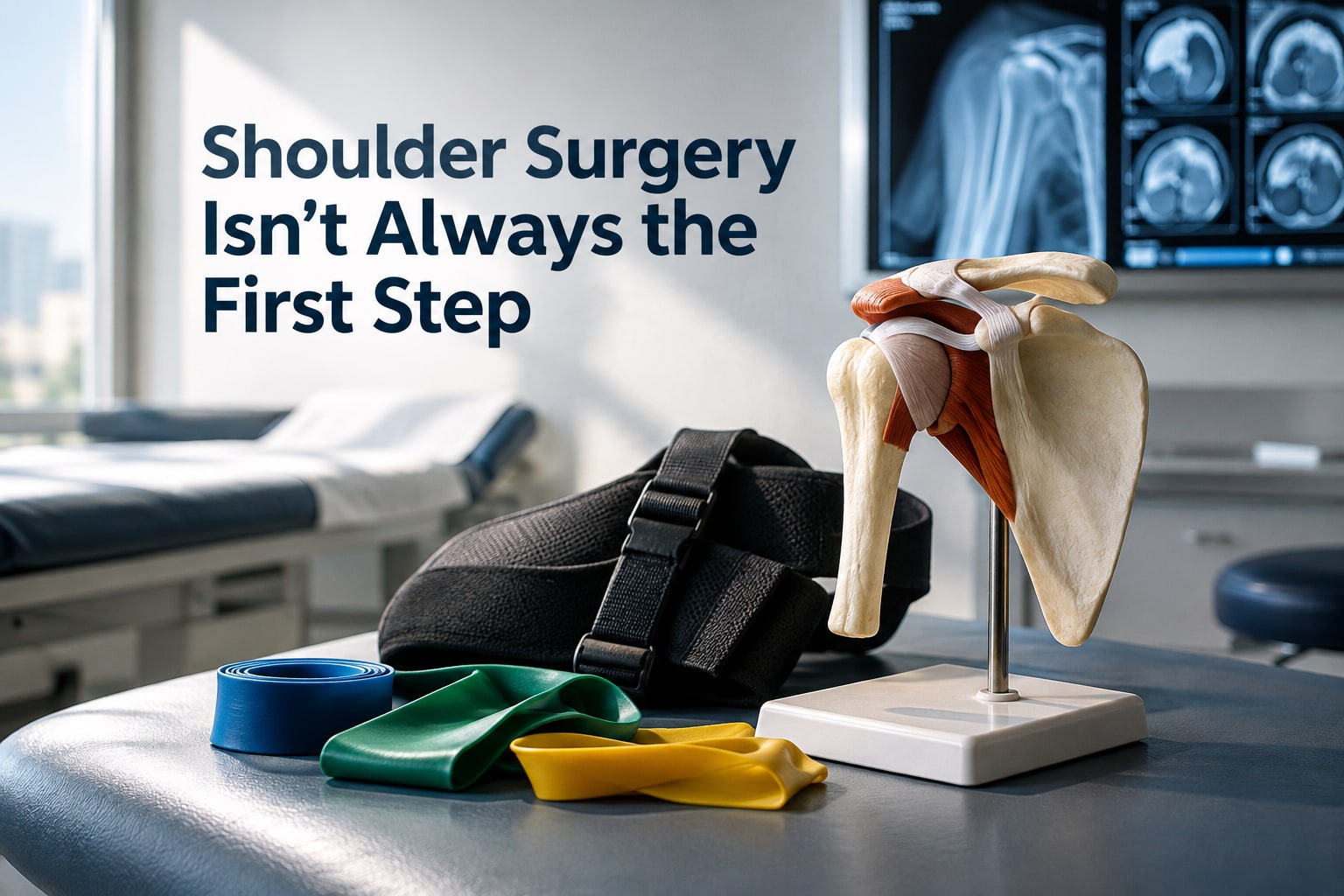
A supervised rehabilitation pathway is usually the better starting point for stable sprains, many rotator-cuff problems, non-displaced injuries, and pain without major weakness or mechanical locking. Conservative shoulder treatment can include activity modification, physiotherapy, taping, bracing, clinician-prescribed medicines, and progressive strengthening.
| Option | What it includes | When it fits |
|---|---|---|
| Rehabilitation | Load reduction, mobility work, support, pain control, and strengthening | Stable sprains, many tendon problems, and non-displaced injuries |
| Arthroscopy for sports injuries | Keyhole assessment, repair, or removal of a specific damaged structure | A locked knee or a repairable traumatic lesion |
| Open surgery | Direct repair, fixation, stabilisation, or replacement | Displaced or unstable injuries and selected major tears |
Surgery becomes more relevant after an acute repairable tendon tear with substantial weakness, recurrent shoulder instability, a locked knee, or a displaced or unstable injury. It is also reasonable to reconsider surgery when functional limitation persists despite a properly supervised programme; joint instability treatment depends on the joint, recurrence, sport, and examination findings.
A corticosteroid injection can provide short-term symptom relief, but it does not repair cartilage, tendon, or ligament. Routine arthroscopic washing or debridement does not reliably treat osteoarthritis, so an abnormal scan alone is not a reason for surgery.
Joint replacement belongs to severe, function-limiting joint disease after non-surgical options fail, not to an imaging abnormality without corresponding pain and loss of function.
What does recovery and return to sport actually require?
Pain-free walking is a milestone, not clearance. Recovery requires control of pain and swelling, restored mobility, progressive strength, proprioception (joint-position control), sport-specific drills, and return to play testing. Sports injury recovery time depends on the tissue and procedure; reduced pain alone does not prove readiness.
Use this checklist before resuming competition:
- Move the joint through its required range without painful restriction or protective guarding.
- Match strength with the uninjured side, including rotator-cuff and shoulder-blade strength after a shoulder injury.
- Complete repeated sport movements without swelling or loss of control.
- Pass return to play testing under the demands of your sport.
Throwing athletes need near-symmetrical shoulder motion, controlled repeated throws, and adequate rotator-cuff and shoulder-blade strength. Lifters need pain-free progressive loading with stable technique. Runners should demonstrate normal walking, hopping, acceleration, deceleration, and cutting. Contact-sport athletes need controlled contact drills without instability or protective guarding.
For knee injuries, testing can include single-leg squats, hop tests, change-of-direction control, and strength comparison. ACL rehabilitation remains essential whether treatment is non-operative or follows reconstruction. The same applies after tendon repair, fracture fixation, arthroscopy, or joint replacement; shoulder rehabilitation is not optional after significant shoulder injury or surgery.
Which clinician should you see first in Hinjewadi?
The safest first appointment depends on the injury, not the scan. Choose emergency care immediately for deformity, a suspected open fracture, absent pulses, progressive numbness, severe pain out of proportion, or a dislocation that cannot be safely assessed.
| Clinician | Best first choice | What happens next |
|---|---|---|
| Emergency department | Red-flag injury or serious trauma | Stabilisation, neurovascular checks, imaging and urgent fracture or dislocation care |
| Sports medicine physician | Non-operative diagnosis, load management and return-to-sport planning | Coordinated examination, rehabilitation and physiotherapist referral |
| Physiotherapist | Graded rehabilitation after serious injury has been assessed | Progressive mobility, strength, balance and sport-specific loading |
| Orthopedic sports injury specialist | Suspected fracture, recurrent dislocation, major weakness, locked joint, instability, or possible arthroscopy or fixation | Examination, imaging interpretation and a treatment decision |
A sports injury specialist in Hinjewadi is not automatically the right first stop for every ache. An orthopedic sports injury doctor becomes more appropriate when structural damage could require fixation or arthroscopy; referral between clinicians is sensible rather than choosing surgery from a scan alone.
Dr Aniruddha Deshmukh-Orthopedic Doctor, Joint Replacement & Arthroscopy Surgeon in Hinjewadi, Pune can assess whether rehabilitation or operative care best fits the examination and imaging.
Related services
Sports Injury Management Sports Injury Management in Hinjewadi, Pune Dr. Aniruddha Deshmukh is a trusted orthopedic doctor specializing in Sports Injury Management in Hinjewadi, Marunji and Pune, providing... View service → |
Shoulder and Elbow Pain Treatment Shoulder and Elbow Pain Treatment in Hinjewadi, Pune Dr. Aniruddha Deshmukh is a trusted Fracture and Trauma Care Specialist in Hinjewadi, Marunji and Pune, providing comprehensive orthopedic care for... View service → |
Frequently asked questions
Which shoulder and joint injuries need specialist assessment?
Arrange specialist assessment for dislocation, suspected rotator cuff or labral tear, recurrent instability, locked knee, suspected ACL or meniscus injury, major swelling, cartilage damage, or persistent pain after a sports injury. Symptoms from the neck or nerves can also mimic shoulder pain.
What should you do during the first 24 to 48 hours?
Protect the injured area, stop sport, use ice wrapped in cloth for short intervals, elevate a swollen limb, and avoid forceful stretching or massage. Seek urgent care for deformity, numbness, severe swelling, an open wound, or inability to use the limb.
When is imaging useful for a shoulder or joint injury?
An X-ray helps identify fractures, dislocation, and some arthritis changes. Ultrasound can assess some tendons and fluid. MRI is useful for suspected ligament, meniscus, labral, cartilage, or rotator cuff damage when examination findings support it.
When is rehabilitation better than arthroscopy or other surgery?
Rehabilitation is often the first choice when the joint is stable, there is no displaced fracture or locked joint, and strength and movement improve with guided treatment. Surgery becomes more relevant for persistent instability, repairable structural tears, or symptoms that limit sport despite adequate rehabilitation.
What does recovery and return to sport require?
Return to sport requires restored range of motion, strength, balance, joint control, and sport-specific movement without swelling or instability. Increase training in stages rather than returning solely because pain has decreased.
Related service
Arthroscopy Surgeon Arthroscopy Surgeon in Hinjewadi, Pune Dr. Aniruddha Deshmukh – Leading Arthroscopy Surgeon in Hinjewadi, Marunji and Pune. Dr. |