Shoulder pain can come from a tendon tear, unstable joint, stiff capsule, arthritis, neck nerve compression or an injury that needs urgent care. By the end, you will know which symptoms need assessment, what tests and treatments to discuss, when arthroscopy fits, and what recovery demands before choosing a surgical plan.
Key takeaways
- Confirm the shoulder lesion before choosing arthroscopy.
- Try appropriate physiotherapy and medication when the diagnosis supports it.
- Open surgery can suit fractures, severe instability, or extensive reconstruction.
- Compare surgeon experience, operation details, rehabilitation, and total follow-up.
Which shoulder problems can an arthroscopy surgeon treat?
Shoulder arthroscopy is a technique, not a diagnosis. An arthroscopy surgeon chooses treatment after identifying the lesion causing your pain, weakness or restricted movement.
| Condition or finding | Patterns that suggest it |
|---|---|
| Rotator cuff tear | Night pain, weakness and pain when lifting the arm overhead; a large or traumatic tear can cause sudden loss of strength. |
| Labral tear, including Bankart or SLAP lesions | Catching, clicking, pain with throwing or overhead activity, or a feeling that the shoulder may slip. |
| Shoulder instability and dislocation | Repeated dislocation, apprehension during certain positions, or persistent looseness after an injury. |
| Impingement or acromioclavicular joint problems | Pain reaching overhead, across the body or behind the back; tenderness over the top of the shoulder can point to the acromioclavicular joint. |
| Cartilage damage or loose bodies | Catching, locking, grinding or an intermittent block to movement. |
| Frozen shoulder | Progressive pain with marked restriction of both active and passive movement, unlike a straightforward cuff problem. |
A rotator cuff tear does not automatically require surgery, and an abnormal MRI alone does not prove that the tendon causes pain. After a fall or crash, seek urgent assessment for deformity, an open wound, severe swelling, numbness, inability to move the arm, or a cold or pale hand.
When does shoulder pain need an orthopedic assessment?
Arrange an orthopedic assessment when shoulder pain persists despite a reasonable period of home care or routine physiotherapy, or when weakness, repeated instability, night pain, catching, or loss of motion interferes with work, sleep, or dressing.
Seek urgent care after high-energy trauma, visible deformity, an open wound, a cold or numb hand, severe swelling, fever, or rapidly worsening redness.
A shoulder pain assessment starts with tenderness, strength, stability, and active versus passive range of motion. A shoulder surgeon uses these findings to build a working diagnosis rather than treating the scan alone.
| Test | What it can show | Important limitation |
|---|---|---|
| Shoulder X-ray | Fracture, alignment, joint-space loss, arthritis, and bone shape | Does not show most tendon or labral tears |
| Shoulder ultrasound | Tendon structure and movement during dynamic testing | Results depend on technique and operator |
| Shoulder MRI | Tendons, labrum, cartilage, muscle quality, and occult structural damage | An abnormality may not cause the pain |
Rotator-cuff changes become more common with age, so an MRI abnormality does not prove that tendon is the pain source. Neck nerve compression, referred pain, arthritis, or infection can mimic shoulder disease and make arthroscopy the wrong treatment.
High-energy trauma also requires assessment for chest, neck, nerve, and other limb injuries instead of assuming the shoulder is isolated.
Should you try non-surgical treatment before arthroscopy?
A rotator cuff tear does not automatically require arthroscopy. If pain and strength remain manageable, non-surgical shoulder treatment can protect function without repair.
| Option | What it involves | When it fits |
|---|---|---|
| Activity modification | Reduce overhead lifting, throwing and painful loading | Symptoms are mild or linked to specific activities |
| Pain relief or anti-inflammatory medicine | Use only medicines medically suitable for you | Short-term pain control helps you exercise and sleep |
| Structured shoulder physiotherapy | Progressive mobility, rotator-cuff and shoulder-blade strengthening | The tear is functioning and weakness is limited |
| Steroid injection | An injection to reduce inflammation and pain | Severe pain blocks rehabilitation; repeated injections need careful discussion |
| Guided rehabilitation | Supervised progression based on symptoms, strength and work or sport goals | Recovery requires monitoring rather than complete rest |
Persistent pain, major weakness, a large tear, an acute traumatic tear or failed non-operative care can shift the balance toward surgery. The decision depends on examination findings, tear size and tissue quality, not an MRI scan alone.
Frozen shoulder treatment usually begins with pain control and mobility-focused physiotherapy. Improvement can take months; manipulation or arthroscopic capsular release is reserved for selected persistent cases.
Arthroscopy is a poor choice for advanced arthritis, untreated infection, neck-related symptoms or a tear that functions well with non-surgical care. Ask what functional gain surgery offers and what happens if you defer it.
What shoulder operations are performed, and when is open surgery better?
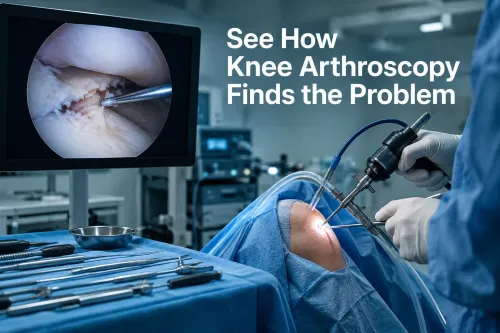
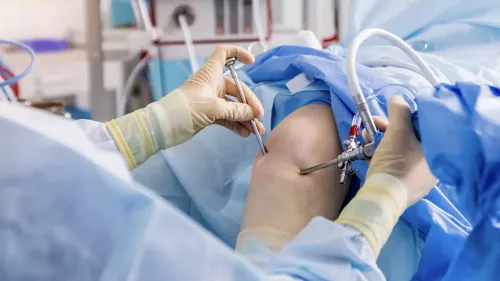
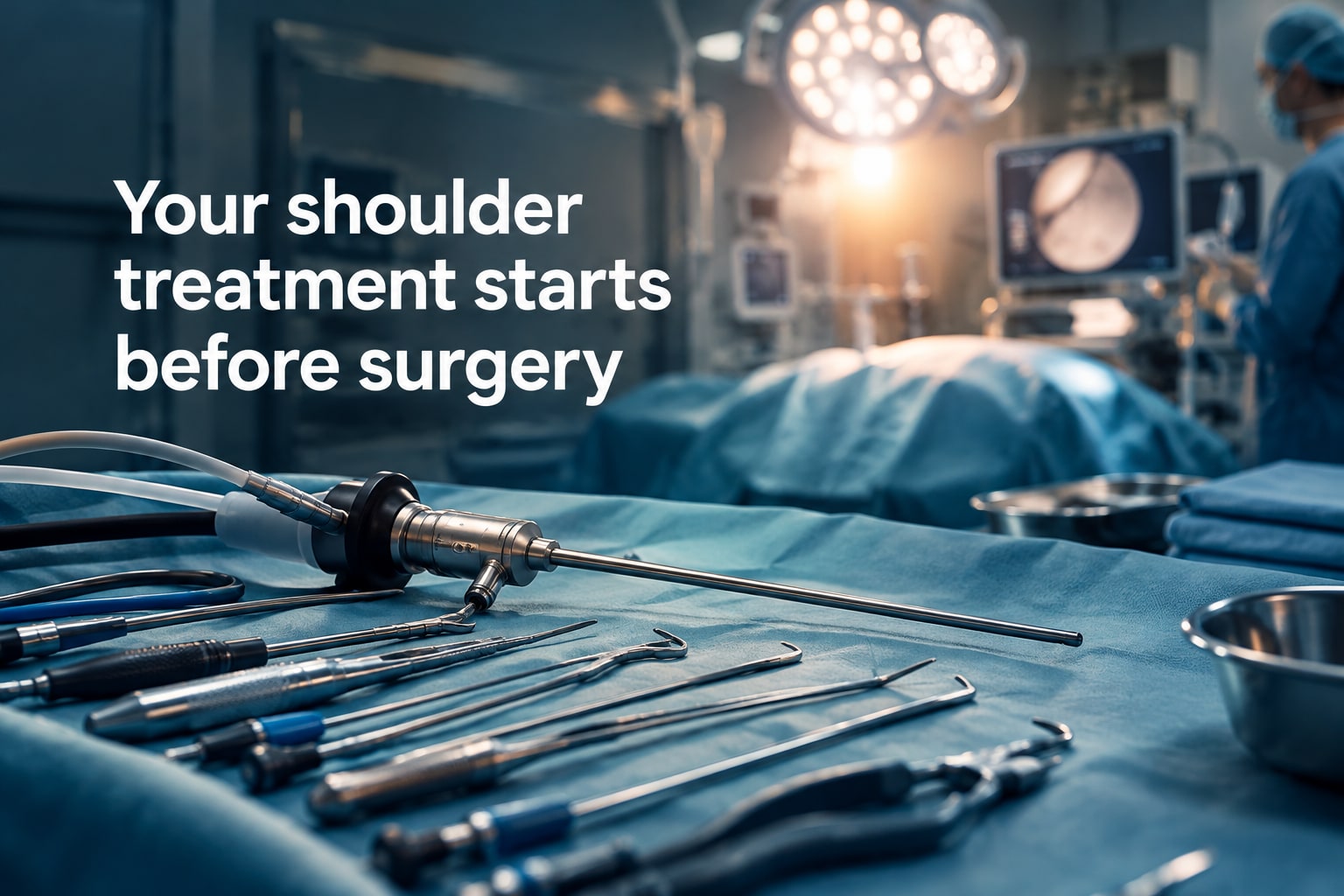
Arthroscopy uses a small camera inserted through a portal. Saline irrigation expands the joint, while separate portals let instruments inspect and repair the labrum, rotator cuff, cartilage, capsule, biceps attachment and subacromial space.
Common procedures include rotator cuff repair, labral or Bankart repair, SLAP treatment, subacromial decompression, loose-body removal and arthroscopic capsular release. These operations treat confirmed lesions; shoulder pain alone does not mean you need one.
| Approach | What it involves | When it fits |
|---|---|---|
| Arthroscopic | Small portals, camera-guided repair and less disruption of surrounding tissue | Repairable cuff or labral tears, selected instability, loose bodies and persistent stiffness |
| Open surgery | A larger incision for direct access, fixation or reconstruction | Large tears, poor tissue quality, substantial bone loss, complex fractures or selected reconstructions |
| Replacement | Joint surfaces are replaced rather than repaired | Advanced arthritis or an unreconstructable joint |
Tear size, tissue quality, bone loss, fracture pattern, arthritis and your work or sport goals guide the choice. Fractures may need a sling, reduction, fixation or replacement—not automatically plating.
Anatomic total shoulder replacement requires a functioning rotator cuff. Reverse shoulder replacement changes joint mechanics and suits selected cuff-deficient arthritis or complex fractures.
What preparation and recovery does shoulder arthroscopy require?
Before consenting, arrange a medication review, including blood thinners and diabetes medicines, and agree how to control glucose on the operation day. Stop smoking in advance, follow the hospital’s exact fasting instructions, and arrange transport home plus an adult to help during the first recovery period; you cannot safely drive after anaesthesia.
1. Shoulder arthroscopy recovery begins with pain control, a sling after shoulder surgery, and limited sleeping positions, often with the operated arm supported. Driving must wait until you can control the vehicle safely, stop suddenly, and no longer take sedating pain medicine.
2. Follow staged exercises exactly. Shoulder physiotherapy rehabilitation usually progresses from protection to permitted range-of-motion work and later strengthening; repeated physiotherapy visits affect work and home routines. Diagnostic arthroscopy often recovers faster than tendon repair, while early loading can damage a repair and prolonged immobilisation can cause stiffness.
3. Discuss shoulder surgery risks, including infection, bleeding, anaesthetic complications, blood clots, nerve or blood-vessel injury, stiffness, failed healing, recurrent instability and persistent pain. Arthroscopy uses small incisions, but it is still surgery.
4. Seek urgent medical attention for fever, worsening redness or drainage, severe swelling, new numbness, a cold hand, chest pain or breathlessness. These signs can indicate infection, circulation problems or a clot.
How do you choose a shoulder surgeon and compare the full treatment plan?
Choose the treatment plan, not the surgeon’s name alone. During a shoulder surgeon consultation, ask for:
- The working diagnosis and examination findings supporting it
- Tear size, tissue quality, repairability, bone loss and arthritis status
- Expected functional gain for your work, sport and daily activities
- Non-surgical alternatives, procedure-specific risks and likely rehabilitation duration
- The consequence of deferring treatment
- The qualification, training and experience specifically related to the proposed operation
Use this shoulder surgery checklist to verify the doctor’s registration in the Indian Medical Register or the current relevant professional register. “Orthopedic surgeon,” “arthroscopy surgeon” and “shoulder specialist” do not prove identical training. Bring X-rays, MRI or ultrasound images and reports, injury details, medication lists and physiotherapy records.
Compare the full shoulder treatment plan across these practical requirements:
| Item | What to compare | Why it matters |
|---|---|---|
| Consultation | Examination, diagnosis and alternatives | A scan alone may identify an unrelated tear |
| Hospital and anaesthesia | Facility, anaesthesia plan and monitoring | These affect preparation and risk |
| Imaging | Existing scans versus new X-rays or MRI | Unnecessary tests add cost and delay |
| Physiotherapy and follow-up | Visit frequency, milestones and total duration | Recovery depends on supervised progression |
For a shoulder-specific assessment, Dr. Aniruddha Deshmukh-Orthopedic Doctor, Joint Replacement & Arthroscopy Surgeon in Hinjewadi, Pune can connect symptoms, imaging and work or sport demands to an appropriate care pathway.
Related services
Arthroscopy Surgeon Arthroscopy Surgeon in Mahalunge, Pune Dr. Aniruddha Deshmukh – Leading Arthroscopy Surgeon in Mahalunge, Sus, Pashan and Pune. Dr. |
Arthroscopy Surgeon Arthroscopy Surgeon in Hinjewadi, Pune Dr. Aniruddha Deshmukh – Leading Arthroscopy Surgeon in Hinjewadi, Marunji and Pune. Dr. |
Frequently asked questions
Which shoulder problems can an arthroscopy surgeon treat?
A shoulder arthroscopy surgeon can treat conditions such as rotator cuff tears, labral tears, shoulder instability, impingement, bursitis, cartilage damage, and some arthritis-related problems. The operation depends on the confirmed lesion, not pain alone.
When does shoulder pain need an orthopedic assessment?
Arrange an orthopedic assessment for pain lasting more than a few weeks, weakness, repeated dislocation, restricted movement, night pain, or symptoms after a fall. Seek urgent care after a major injury, visible deformity, or sudden inability to lift the arm.
Should you try non-surgical treatment before arthroscopy?
When there is no urgent fracture, dislocation, infection, or major tendon injury, treatment often starts with activity modification, physiotherapy, pain relief, and injections when appropriate. Surgery becomes a consideration when symptoms persist or the diagnosis requires repair.
What shoulder operations are performed, and when is open surgery better?
Arthroscopic procedures include rotator cuff repair, labral repair, stabilisation, decompression, and removal of inflamed tissue. Open surgery can be better for some fractures, joint replacements, severe bone loss, or repairs that need direct access.
What preparation and recovery does shoulder arthroscopy require?
Ask about preoperative imaging, medication changes, fasting, anaesthesia, sling use, wound care, driving restrictions, physiotherapy, and expected return to work. Recovery varies by procedure, with tendon and stabilisation repairs requiring longer protection than diagnostic or minor procedures.
Related services
Arthroscopy Surgeon Arthroscopy Surgeon in Baner, Balewadi, Pune Dr. Aniruddha Deshmukh – Leading Arthroscopy Surgeon in Baner, Balewadi, and Pune. Dr. View service → |
Arthroscopy Surgeon Arthroscopy Surgeon in Pimple Saudagar, Pune Dr. Aniruddha Deshmukh – Leading Arthroscopy Surgeon in Pimple Saudagar, Pimple Gurav, Rahatani and Pune. Dr. |
Arthroscopy Surgeon Arthroscopy Surgeon in Wakad, Pune Dr. Aniruddha Deshmukh – Leading Arthroscopy Surgeon in Wakad, Pimple Nilakh, Thergaon and Pune. Dr. |
Arthroscopy Surgeon Arthroscopy Surgeon in Punawale, Pune Dr. Aniruddha Deshmukh – Leading Arthroscopy Surgeon in Punawale and Pune. Dr. |