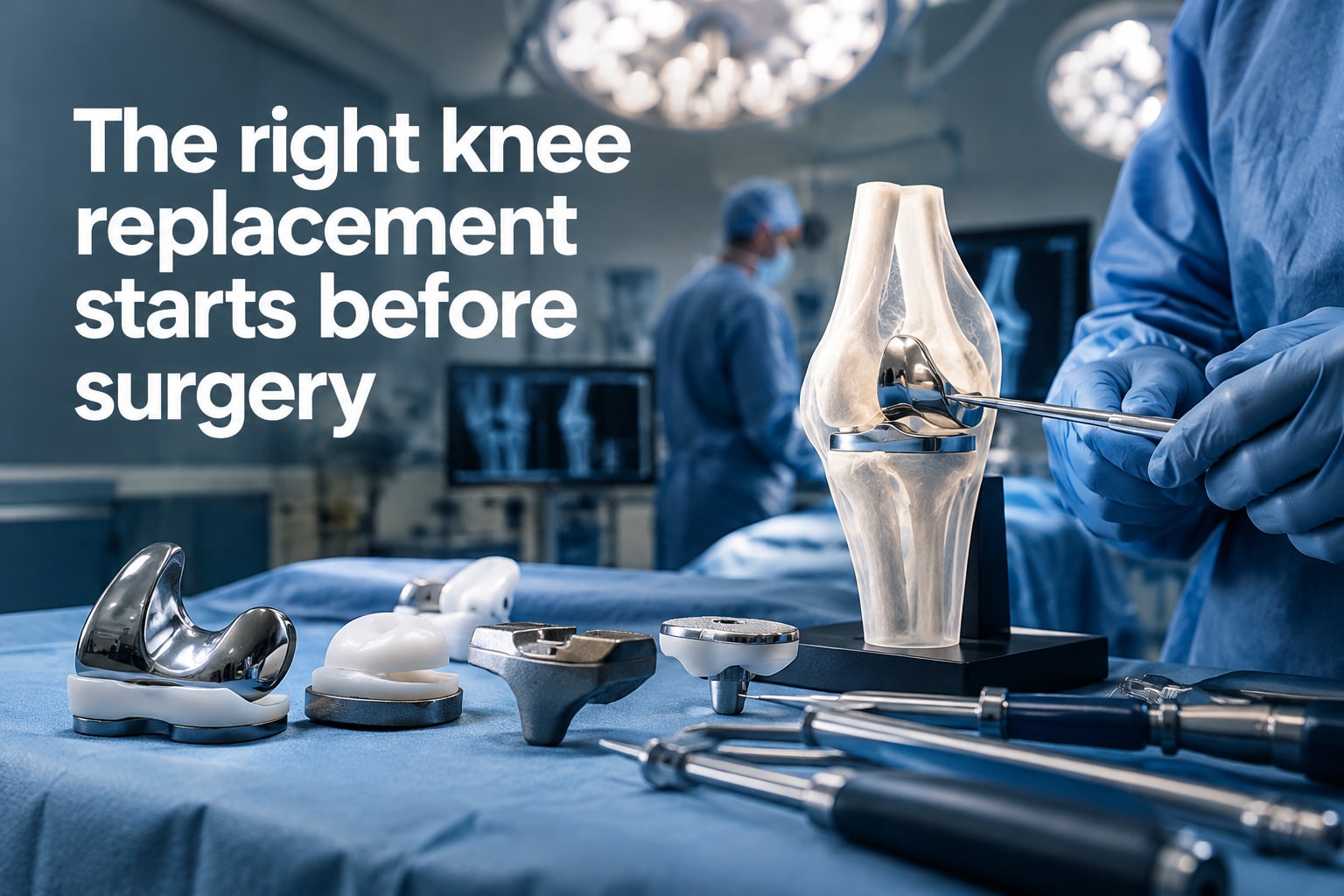
A knee replacement consultation starts with your pain, walking ability, examination and previous treatment—not an automatic decision to operate. By the end of the process, you should understand whether replacement is appropriate, which procedure fits your knee, what preparation involves and how to assess the surgeon and hospital.
Key takeaways
- Your first consultation does not automatically lead to knee replacement surgery.
- Surgery decisions combine symptoms, examination findings, X-rays and previous treatment results.
- Partial replacement suits disease limited to one knee compartment; total replacement treats wider damage.
- Plan transport, home support, exercises and follow-up before your operation.
What to expect at the first knee replacement consultation
The first appointment covers your knee pain history, walking limitation, examination findings and previous treatment; it does not automatically lead to surgery. The surgeon will ask when pain began, where it hurts, whether it wakes you at night, and how it affects work, sleep and daily activities.
Explain any difficulty climbing stairs, standing, sitting, driving or walking on uneven ground.
The surgeon will usually check:
- Your walking pattern, limp, knee alignment and visible swelling or deformity
- Tenderness, warmth, muscle wasting and the knee’s range of motion
- Ligament stability, leg strength and pain during bending or straightening
- Whether hip or spine problems could be contributing to your symptoms
- Medical conditions, allergies, previous injuries, operations and current medicines
- What you have already tried, including physiotherapy, exercise, weight-management support, tablets, topical medicines, injections or a walking aid
Bring your medication list, previous X-rays or MRI scans, radiology reports, blood-test records, details of diabetes or heart, lung and kidney conditions, and notes from earlier operations. Include the injection name and date if you received one.
The surgeon reviews imaging alongside your symptoms and examination; an X-ray alone does not decide treatment. Persistent rest or night pain, marked loss of motion, deformity, and inability to walk or climb stairs can indicate advanced arthritis, but the consultation also identifies treatments worth trying before replacement.
How the surgeon decides whether you need knee replacement
Replacement is considered when severe knee arthritis symptoms remain disabling despite a properly tried non-surgical plan. The surgeon assesses pain at rest, night pain, walking and stair limits, knee deformity, loss of motion, strength, alignment and daily function. X-ray findings support the diagnosis, but they do not decide it alone; symptoms and examination must match.
| Option | What it does | When replacement moves ahead |
|---|---|---|
| Physiotherapy | Builds strength, improves movement and reduces strain | Pain and disability persist after a structured programme |
| Weight management | Reduces load through the knee and surgical risk | Symptoms remain limiting despite achievable weight reduction |
| Medicines | Topical or oral drugs control pain and inflammation | Relief is inadequate, temporary or limited by side effects |
| Corticosteroid injection | Can provide short-term symptom relief | Pain returns and function remains poor after the injection wears off |
| Walking aid | A cane or walker improves stability and reduces loading | You still cannot walk safely or manage stairs |
| Arthroscopy | Treats selected problems such as a loose body or true locking | It is not a treatment for worn cartilage or routine osteoarthritis |
| Knee replacement | Replaces damaged joint surfaces to restore function | Disability remains substantial after appropriate alternatives |
The decision also includes medical conditions, current medicines, previous treatments and your goals. Arthroscopy is usually the wrong choice for pain from arthritis alone. Replacement becomes reasonable when pain restricts ordinary life, non-operative care has failed, and the expected functional gain outweighs surgical risks and implant revision concerns.
Partial, total or robotic knee replacement: which option fits?
The choice depends on where the arthritis is, whether the supporting ligaments still work, and how the knee alignment has changed. A partial knee replacement suits disease confined to one of the three knee compartments, with a functional ligament system and correctable alignment. Damage across multiple compartments usually points to a total knee replacement.
| Option | What it means | When it fits |
|---|---|---|
| Partial knee replacement | Replaces the worn surface in one compartment while preserving more bone and healthy knee tissue | Arthritis is limited to one compartment, knee alignment is acceptable, and the ligament condition supports stability |
| Total knee replacement | Replaces damaged femoral and tibial joint surfaces with metal components and a polyethylene spacer; the kneecap underside may also be resurfaced | Arthritis affects several compartments, deformity is substantial, or major ligament damage prevents reliable stability |
| Robotic-assisted replacement | Uses three-dimensional planning and instruments to guide bone cuts and component positioning; it is not a different implant | The surgeon expects measurable planning or alignment value in your anatomy, whether the operation is partial or total |
A total knee replacement does not replace your entire leg or recreate a completely natural knee. The surgeon chooses the operation after examining movement, stability and weight-bearing alignment, then reviewing X-rays that show compartment damage.
Robotic assistance cannot repair a failing ligament or guarantee better long-term results. Ask what specific measurement or correction it adds in your case, and whether the same implant and rehabilitation plan would be used without it.
What happens before, during and after the operation
1. Before surgery, the preoperative assessment checks whether you are fit for anaesthesia and recovery. Expect blood tests and ECG, blood-pressure and diabetes review, medication instructions, chest assessment when indicated, and dental infection screening; an untreated infection can postpone the operation. Bring scan reports, previous operation notes and your complete medicine list.
2. The anaesthetist reviews your heart, lungs, allergies and previous anaesthesia before choosing spinal or general anaesthesia. During a total replacement, the surgeon removes damaged cartilage and bone, places a metal femoral component and tibial component with a polyethylene spacer, and may resurface the kneecap. The operation commonly takes one to two hours.
Robotic assistance supports planning and bone cuts; it is not a different implant or a guarantee of better long-term results.
3. After surgery, staff monitor your wound, pain, blood pressure and leg circulation. You usually begin ankle exercises, sit up and walk with assistance soon after the operation.
Physiotherapy then works on knee bending, straightening, quadriceps strength, transfers and safe stair use; discharge may be the same day or later if mobility or medical needs require it.
4. Ask for a written plan covering wound infection, deep infection, blood clots, stiffness, persistent pain, nerve or blood-vessel injury, instability, fracture around the implant, loosening and wear. Clot prevention may combine early movement, ankle exercises, compression measures and an anticoagulant, selected according to bleeding and clotting risks.
Report calf swelling, chest pain, fever, wound drainage or sudden worsening pain urgently; a successful replacement does not guarantee a pain-free, natural-feeling knee.
How to choose and prepare for a knee replacement surgeon in Pimple Saudagar
Verify four things before you book surgery: the surgeon’s credentials, the implant being proposed, the knee replacement rehabilitation plan and the response available if recovery goes wrong. A consultation with Dr Aniruddha Deshmukh-Orthopedic Doctor, Joint Replacement & Arthroscopy Surgeon in Hinjewadi, Pune should leave you with specific answers, not only a procedure date.
- Check the orthopaedic surgeon qualifications, recognised orthopaedic training, joint-replacement experience and who will perform each part of the operation. Confirm the doctor’s name and registration on the National Medical Commission register.
- Request implant documentation showing the manufacturer, model, size range, fixation method, bearing material and the implant sticker or operative record you will receive after surgery. Ask why that implant suits your bone quality, age and activity.
- Get a written knee replacement rehabilitation plan: when walking starts, physiotherapy frequency, expected milestones, home exercises, driving restrictions and who supervises progress.
- Ask for the hospital’s emergency number, after-hours contact, wound-review process and instructions for fever, increasing swelling, calf pain, drainage or breathlessness. Confirm who handles infection, implant loosening or revision surgery.
| Check | Acceptable answer | Warning sign |
|---|---|---|
| Surgeon | Named operator and verified credentials | Unclear substitute surgeon |
| Implant | Brand, model and records supplied | “Standard implant” only |
| Rehabilitation | Dates, exercises and named coordinator | Advice to “walk as tolerated” |
| Emergency support | 24-hour pathway and hospital contact | No after-hours arrangement |
Bring your medication list and prior scans, then ask for a second opinion if answers remain vague. Clear documentation is part of safe decision-making, not administrative detail.
Related services
Knee Replacement Surgeon Knee Replacement Surgeon in Pimple Saudagar, Pune Dr. Aniruddha Deshmukh – Leading Knee Replacement Surgeon in Pimple Saudagar, Pimple Gurav, Rahatani and Pune. Dr. |
Joint Replacement Surgeon Joint Replacement Surgeon in Pimple Saudagar, Pune Dr. Aniruddha Deshmukh – Leading Joint Replacement Surgeon in Pimple Saudagar, Pimple Gurav, Rahatani and Pune. |
Frequently asked questions
What happens at the first knee replacement consultation?
The surgeon reviews when your pain began, its location, night symptoms, walking limits, work and sleep effects, previous treatments, examination findings and relevant imaging.
How does a surgeon decide whether knee replacement is necessary?
The decision combines your pain and activity limitations, examination findings, imaging results and response to non-surgical treatment. A scan alone does not determine the need for surgery.
What is the difference between partial and total knee replacement?
Partial replacement treats damage confined to one knee compartment when the remaining joint structures are suitable. Total replacement replaces the damaged joint surfaces across the knee.
What does robotic knee replacement mean?
Robotic assistance supports planning and execution during knee replacement. It does not replace the surgeon's assessment, surgical decisions or postoperative rehabilitation.
How should you prepare for knee replacement surgery?
Discuss medicines and medical conditions with the surgical team, arrange transport and home help, prepare the recovery area, and understand exercises, wound care and follow-up appointments.
Related service
Robotic Knee Replacement Surgeon Robotic Knee Replacement Surgeon in Pimple Saudagar, Pune Dr. Aniruddha Deshmukh is the Trusted Robotic Knee Replacement Surgeon in Pimple Saudagar, Pimple Gurav, Rahatani and Pune. Dr. |