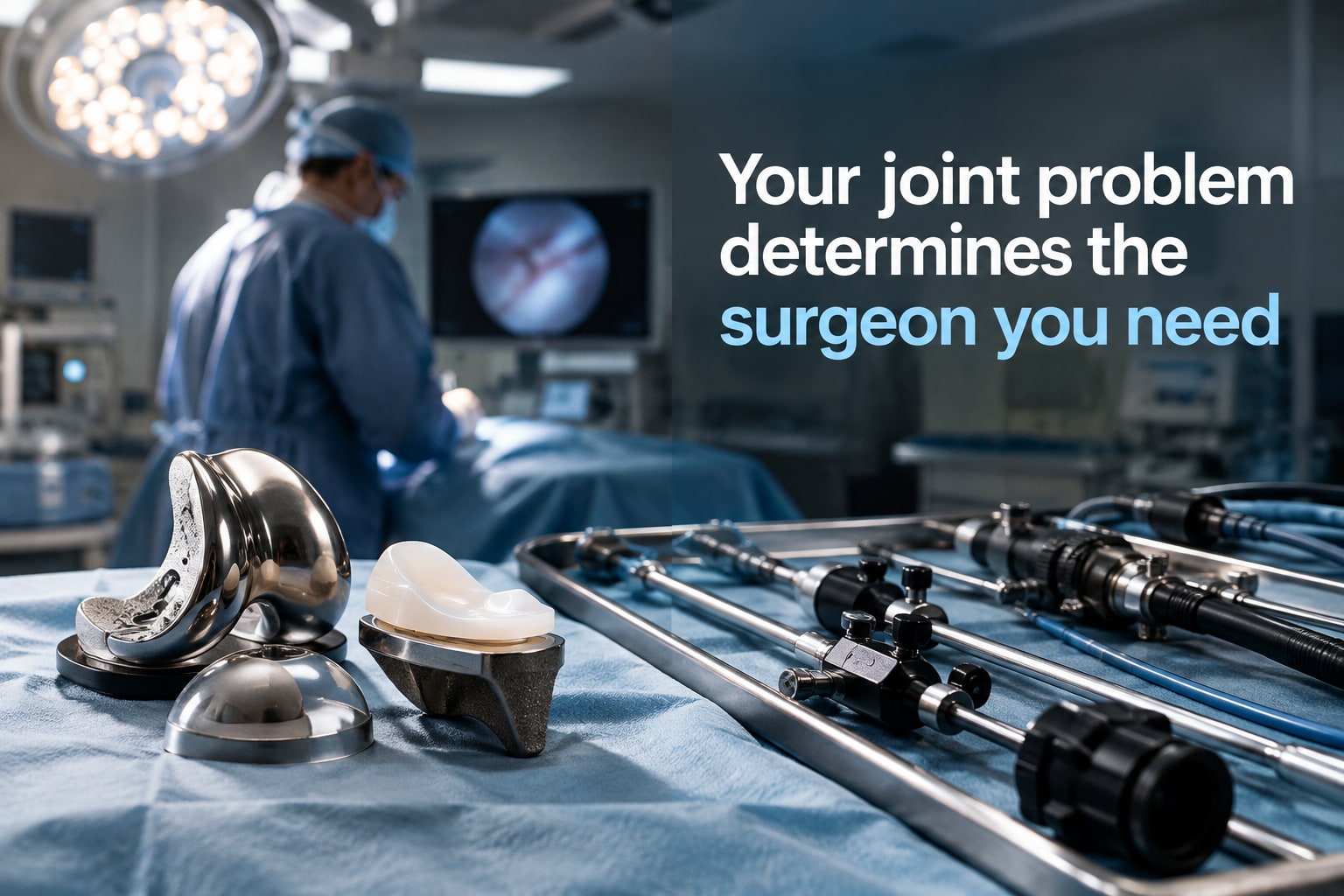
Choosing an orthopaedic surgeon requires more than searching for the words “robotic,” “leading” or “trusted.” You need to match the surgeon’s procedure experience, diagnostic approach, hospital support and follow-up plan to your symptoms, examination findings and recovery needs.
Key takeaways
- Start with an orthopaedic examination for new pain, swelling or injury.
- Replacement becomes relevant when arthritis limits daily life despite non-surgical treatment.
- Ask whether partial, total or robotic replacement suits your knee anatomy.
- Check the surgeon’s shoulder expertise, facility standards and follow-up plan.
Which knee surgeon is right for your problem?
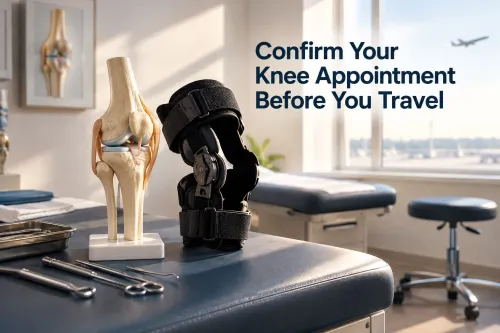
New knee pain, an injury, arthritis or unexplained swelling calls for a general orthopaedic surgeon first. They can examine you, begin non-surgical treatment and refer you when replacement becomes relevant.
| Surgeon type | What the label means | What to expect |
|---|---|---|
| General orthopaedic surgeon | Assesses a broad range of bone and joint problems | Diagnosis, initial treatment and referral when needed |
| Knee replacement surgeon | Performs and plans knee replacements | Discussion of implant choices, partial versus total replacement, ligament stability, medical optimisation and rehabilitation |
| Robotic knee replacement surgeon | Uses a planning and execution system during replacement | Computer-assisted bone cuts and alignment; not a separate implant or proof of better outcomes |
Choose a knee replacement surgeon when persistent pain and loss of function remain despite suitable treatment. The surgeon must explain alternatives and why replacement fits your knee, not simply recommend surgery from an X-ray.
Before deciding, ask:
- Will you personally perform the operation?
- How many knee replacements do you perform, and how many use robotic assistance?
- Which hospital provides anaesthesia and inpatient care?
- How are infection, stiffness, clot, nerve injury and revision managed?
- What are your infection and revision rates?
- Who provides physiotherapy, and how quickly can I obtain follow-up?
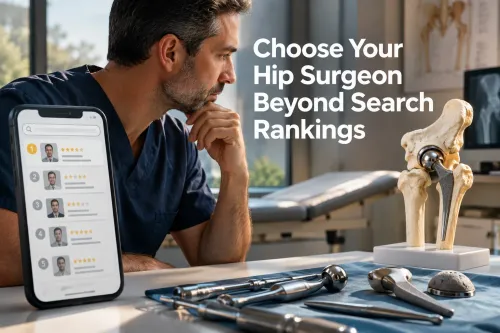
Verify the doctor’s registration through the National Medical Commission’s Indian Medical Register. Treat “robotic” as a method, not a quality guarantee; compare the complete care pathway and follow-up availability.
When does knee arthritis justify replacement?
Replacement deserves discussion when knee osteoarthritis causes persistent pain that limits walking, sleep, work, stairs or personal care despite suitable treatment. These are the core knee replacement indications; an X-ray finding alone is not enough.
| Option | What supports it | What to check |
|---|---|---|
| Continue non-surgical care | Symptoms remain manageable and function is preserved | Exercise-based physiotherapy, weight management where relevant, pain medicines and injections |
| Discuss replacement | Pain and disability substantially reduce quality of life | Why each treatment failed, was unsuitable or provided too little relief |
| Investigate another diagnosis | Unusual pain, locking, instability, fever or rapid deterioration | Meniscal or ligament injury, infection, tumour or another cause |
Ask specifically about physiotherapy before surgery and why it has or has not improved your strength, movement and daily function. Your surgeon should examine range of motion, swelling, deformity and ligament stability before recommending an operation.
Standing X-rays show joint-space loss, alignment and the pattern of wear under load. MRI is not routinely needed for straightforward knee osteoarthritis when symptoms and plain radiographs fit; request further investigation when symptoms are atypical or another condition is suspected.
Replacement becomes more reasonable when effective non-surgical care has been exhausted or is unsuitable, and the remaining pain—not the scan—determines that you cannot live normally.
Partial, total or robotic knee replacement: what changes?
A partial knee replacement resurfaces one compartment: the medial, lateral or patellofemoral compartment. It preserves the other compartments and suits disease confined to that area, functioning major ligaments and a correctable deformity.
A total knee replacement resurfaces damaged surfaces across the knee, including the femoral and tibial sides and, when indicated, the back of the kneecap.
| Option | What it changes | When it applies |
|---|---|---|
| Partial knee replacement | Replaces one diseased compartment and preserves the rest of the knee | Arthritis is confined to one compartment, major ligaments function and deformity is correctable |
| Total knee replacement | Resurfaces the damaged femoral and tibial surfaces and sometimes the kneecap’s back | Disease affects multiple compartments or a partial replacement is unsuitable |
| Robot-assisted knee replacement | Uses a three-dimensional plan to guide bone cuts and knee balancing | Either partial or total replacement when the surgeon considers the system useful |
Partial knee replacement is not simply a smaller total knee replacement. Ask why your disease pattern fits it, and ask how ligament stability, deformity and the other compartments affect that decision.
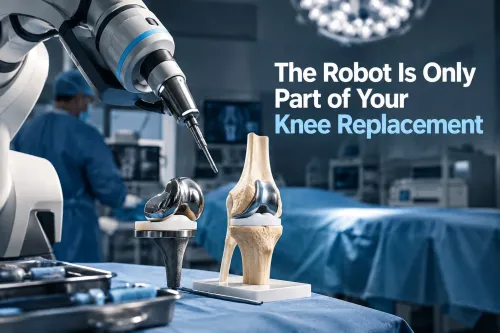
Robot-assisted knee replacement is an assistance method, not a separate implant. It can reduce variation in alignment and help with execution, but it does not choose your implant, replace surgical judgment or remove infection, clot, stiffness, nerve injury or revision risk.
Evidence does not consistently show better pain, function or revision outcomes than accurately performed conventional surgery. Discuss implant selection in relation to your bone quality, ligaments and activity goals, and do not assume robotic assistance guarantees faster rehabilitation.
What should you ask at a Hinjewadi knee consultation?
Take a checklist and use one complete consultation to compare surgeons, not titles. Ask, “Will you review my standing X-rays with me?” Then ask whether your ligaments are stable, whether the deformity is correctable, and which operation and implant the surgeon recommends, including the alternative.
- Ask for the surgeon surgical volume for the relevant knee procedure, hospital affiliation, infection and revision figures, implant systems used, and the method for recording complications.
- Confirm who will perform the operation, anaesthesia and each other part of your care.
- Confirm physiotherapy access, thrombosis-prevention protocol, wound review schedule and emergency contact.
- Ask about hospital stay, dressing changes, pain-control options and physiotherapy frequency.
- Ask how the hospital will assess fever, wound drainage, calf swelling, sudden weakness or worsening pain.
Compare the answers against this care pathway:
| Question | Clear answer to record | Why it matters |
|---|---|---|
| Operation | Recommended procedure, implant and alternative | Shows the decision fits your ligaments, deformity and disease pattern |
| Safety | Infection, clot, revision and complication records | Reveals how outcomes are measured |
| Follow-up | Named contact, wound review and escalation plan | Prevents delays when problems develop |
Ask for a written knee replacement recovery timeline covering assisted walking, independent walking, stairs, driving, desk work, physical work and ordinary daily activities. Exact milestones depend on examination, health and the treating surgeon’s protocol.
Judge a consultation with Dr Aniruddha Deshmukh-Orthopedic Doctor, Joint Replacement & Arthroscopy Surgeon in Hinjewadi, Pune by these specific answers and the follow-up pathway, not by a title alone.
Related services
Knee Replacement Surgeon Knee Replacement Surgeon in Hinjewadi, Pune Dr. Aniruddha Deshmukh – Leading Knee Replacement Surgeon in Hinjewadi, Marunji and Pune. Dr. View service → |
Joint Replacement Surgeon Joint Replacement Surgeon in Hinjewadi, Pune Dr. Aniruddha Deshmukh – Leading Joint Replacement Surgeon in Hinjewadi, Marunji and Pune. View service → |
How should you choose a shoulder surgeon and care facility?
An MRI finding is not a diagnosis. A rotator cuff tear can exist without causing pain, so a shoulder surgeon should compare the scan with your symptom pattern, range of motion, strength testing and examination findings.
| Pattern | What to check | Usual next step |
|---|---|---|
| Atraumatic cuff problem | Pain, weakness, tear size and activity demands | Activity modification, structured physiotherapy and pain control |
| Frozen shoulder | Marked restriction of both active and passive movement; diabetes is a risk factor | Pain control, mobility-focused therapy, then procedures if needed |
| Cuff-tear arthritis | Irreparable cuff deficiency and arthritic joint changes | Discuss reverse shoulder replacement |
| Cuff functioning with damaged joint | Preserved rotator-cuff function | Discuss anatomic shoulder replacement |
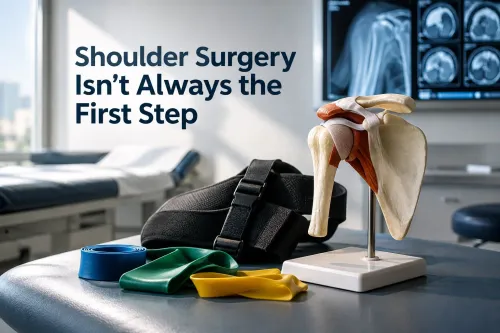
A visible tear does not automatically require surgery. Ask which weakness, tear characteristic, activity demand or failed rehabilitation result would change the plan. Subacromial decompression or acromioplasty should not be presented as a routine cure for nonspecific impingement.
Choose a facility with documented follow-up, physiotherapy access and imaging that the surgeon can review alongside examination findings. For fracture trauma care around Hinjewadi, confirm access to urgent imaging, reduction, fixation, anaesthesia, blood support when needed and documented neurovascular checks.
Seek emergency assessment for:
- An absent pulse or progressive numbness
- Threatened skin, an open fracture or severe deformity
- A traumatic injury with rapidly worsening pain, swelling or loss of function
Frequently asked questions
Which knee surgeon is right for your problem?
Start with a general orthopaedic surgeon for new knee pain, injury, arthritis or unexplained swelling. Choose a knee replacement specialist when examination and treatment history indicate that surgery is relevant.
When does knee arthritis justify replacement?
Knee replacement becomes relevant when arthritis causes persistent pain and limits walking, work, sleep or daily activities despite appropriate non-surgical treatment.
What changes between partial, total and robotic knee replacement?
Partial replacement treats damage limited to one knee compartment, while total replacement resurfaces the damaged areas across the knee. Robotic assistance changes surgical planning and instrument guidance, not the underlying need for suitable patient selection.
What should you ask at a Hinjewadi knee consultation?
Ask about the diagnosis, non-surgical alternatives, recommended procedure, expected recovery, implant choice, risks, rehabilitation schedule and the surgeon’s follow-up plan.
How should you choose a shoulder surgeon and care facility?
Check the surgeon’s experience with your shoulder condition and confirm that the facility provides appropriate imaging, anaesthesia, surgery, physiotherapy and follow-up care.
Related service
Robotic Knee Replacement Surgeon Robotic Knee Replacement Surgeon in Hinjewadi, Pune Dr. Aniruddha Deshmukh is the Trusted Robotic Knee Replacement Surgeon in Hinjewadi, Marunji and Pune. Dr. View service → |