An active person needs more than advice to rest after pain, swelling, weakness, or a sudden injury. By the end, you will know when to seek urgent help, what an orthopedic assessment examines, how treatment options compare, and which milestones support a safer return to exercise or sport.
Key takeaways
- Seek urgent care for deformity, open fractures, pale limbs, paralysis, or major trauma.
- Expect movement tests, strength checks, imaging, and questions about your activity goals.
- Return to loading gradually by following pain, swelling, strength, and range-of-motion guidance.
- Shoulder pain needs a specific diagnosis because tendons, instability, and joints require different treatment.
When an injury needs urgent care or an appointment
A visibly deformed limb, an open fracture, a cold or pale hand or foot, new paralysis or numbness, or inability to bear weight after significant trauma needs urgent assessment. Fractures and dislocations can damage nerves or blood vessels, so do not drive yourself if the injury is severe.
Arrange a prompt orthopedic appointment for a joint that repeatedly gives way, locks, remains swollen, hurts more during exercise, or fails to improve after you reduce activity. Ordinary post-training soreness usually affects the muscles you worked and gradually eases over several days; sharp, localised pain or sudden weakness is different.
During the first 24 to 48 hours:
- Stop the activity that worsens the pain and protect the area from further loading.
- Apply ice wrapped in cloth for short intervals; never place ice directly on skin.
- Use compression only while it does not cause numbness, tingling, increased pain, or colour change.
- Elevate the injured limb when practical.
- Avoid forceful stretching or massage over a suspected fracture, dislocation, or tendon rupture.
An orthopedic surgeon in Punawale for active patients may apply the Ottawa Ankle Rules after ankle trauma. X-rays are indicated for tenderness at the posterior edge or tip of either malleolus, the base of the fifth metatarsal, or the navicular, or when you cannot walk four steps.
This avoids imaging every ankle sprain while identifying common fracture patterns.
What happens during an active-patient orthopedic evaluation
Normal delayed-onset muscle soreness follows a new or harder workout, affects the exercised muscles on both sides or across a broad area, and gradually eases over several days.
A sharp or localized pain, bruising, sudden weakness, a pop, lost motion, night pain, swelling, instability, or pain that returns whenever you load the area needs assessment rather than repeated rest-and-retry.
Your evaluation usually examines:
- How the injury happened, including a twist, fall, collision, lift, or gradual training increase
- Training volume, previous injuries, footwear, equipment, work demands, and the activity you want to resume
- Gait and movement, joint range of motion, muscle strength, tendon function, ligament stability, circulation, and sensation
- Sport-specific tasks, such as hopping, squatting, changing direction, throwing, or reaching overhead
An X-ray helps assess a fracture, bone alignment, or joint position. Ultrasound can examine accessible tendons and fluid while you move. MRI provides detail about ligaments, cartilage, menisci, the labrum, and deep soft tissue.
An orthopedic surgeon punawale in pune interprets these images alongside your symptoms and examination, not as a diagnosis in isolation. A scan can show an old change or an incidental finding that does not explain your pain.
The useful diagnosis connects the physical finding with the load that triggers symptoms and the activity you need to regain.
How treatment choices support a gradual return to loading
Treatment starts with the least invasive option that can safely restore loading, not automatically with surgery. Conservative care may combine activity modification, a brace or protected weight-bearing, medically appropriate pain relief, and a staged home programme. It is unsuitable for an unstable fracture, major tendon rupture, neurovascular compromise, or a dislocation requiring reduction.
| Option | What it involves | When it fits |
|---|---|---|
| Conservative care | Protection, symptom control, and staged loading | Stable injuries without major structural failure |
| Physiotherapy | Motion, strength, balance, landing control, and technique | Recovery when movement is safe; it cannot correct every displaced or mechanically blocked injury |
| Injection | Targeted treatment for selected inflammatory or joint symptoms | Only after a diagnosis-specific risk discussion; it cannot reunite a torn ligament or stabilize an unstable fracture |
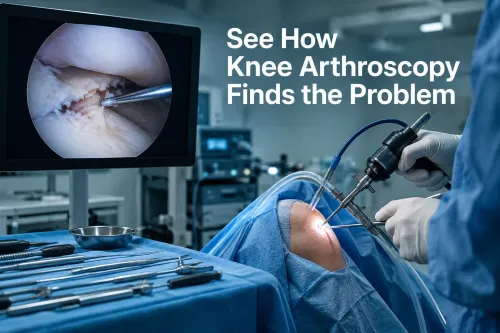
| Arthroscopy | Small portals to treat selected cartilage, meniscal, ligament, or shoulder problems | A defined mechanical problem; not routine for uncomplicated degenerative knee pain, where lavage and debridement offer little lasting benefit |
| Open reduction or fixation | Restoring alignment and stabilizing bone or joint structures | Displacement, instability, joint-surface involvement, soft-tissue damage, poor bone quality, or high functional demands |
Prolonged immobilization can cause stiffness, muscle loss, and reduced confidence. Once healing permits, a sports injury doctor Punawale patients consult should set measurable progression criteria, such as range of motion, swelling, strength, gait, balance, and task tolerance, before increasing load. Pain alone is not clearance.
Why shoulder pain needs a more specific decision
Shoulder pain needs a specific decision because the same symptom can reflect rotator-cuff tendinopathy, a partial or full-thickness tear, instability, labral injury, or frozen shoulder. Pain during overhead reaching, weakness when lifting or rotating, night pain, clicking, or a shoulder that slips out deserves more than a generic rest recommendation.
| Finding | More consistent with | Decision point |
|---|---|---|
| Pain with loading but preserved strength | Tendinopathy or minor tear | Reduce aggravating loads and begin structured exercises |
| Sudden weakness after injury | Significant cuff tear | Arrange prompt shoulder assessment |
| Repeated slipping or dislocation | Instability or labral injury | Assess recurrence risk before returning to sport |
| Marked loss of active and passive motion | Frozen shoulder or joint restriction | Seek diagnosis rather than forcing stretches |
The examination should compare active and passive range of motion, resisted strength, scapular control, instability signs, and the injury history. An MRI finding alone does not decide whether surgery is needed. Initial care for many cuff problems combines load reduction, appropriate anti-inflammatory treatment, and guided exercises.
Surgery becomes more relevant after a traumatic tear with substantial weakness, persistent pain or weakness despite well-delivered non-operative care, a large or progressing tear, or recurrent instability that blocks safe contact or overhead sport. Age, dislocation count, bone loss, sport, and examination findings shape rehabilitation versus stabilisation surgery.
A shoulder surgeon in Punawale should connect those findings to swimming, throwing, racquet sport, gym pressing, or field-sport demands.
How rehabilitation turns treatment into an active-life plan
Pain is not clearance: rehabilitation earns a return to activity through measurable function, sport-specific drills, and gradual loading.
| Sport | Rehabilitation focus | Safe progression |
|---|---|---|
| Runners | Impact exposure, cadence or training-load review, single-leg strength | Walk-jog intervals before continuous running |
| Cyclists | Bike position, knee tracking, low-resistance control | Increase resistance and duration separately |
| Gym users | Technique changes, range of motion, controlled strength | Add load in stages without compensating |
| Swimmers and racquet players | Shoulder range, strength, and overhead endurance | Progress stroke, serving, and hitting volume |
| Field-sport players | Cutting, sprinting, landing, and contact skills | Add drills before full-speed competition |
| Recreational exercisers | A plan matching available time | Avoid abrupt increases in weekly volume |
After ACL injury, use full motion, minimal swelling, a stable examination, strength symmetry, neuromuscular control, psychological readiness, and sport-specific drills—not a calendar date—as return criteria. Returning too early can expose the knee to reinjury.
After fracture care, arthroscopy, ligament treatment, or joint replacement, track gait, motion, strength, swelling, and task tolerance. Prolonged immobilization causes stiffness, muscle loss, and reduced confidence, so loading should progress once healing permits.
Joint replacement is considered for disabling pain and lost function despite appropriate non-surgical care, not an X-ray alone. Walking, cycling, and swimming are commonly more suitable than repeated high-impact loading, subject to individual advice.
Dr Aniruddha Deshmukh-Orthopedic Doctor, Joint Replacement & Arthroscopy Surgeon in Hinjewadi, Pune can connect these milestones with an orthopedic care punawale plan that includes prevention.
Related services
Orthopedic Surgeon Orthopedic Surgeon in Punawale, Pune Dr. Aniruddha Deshmukh – Trusted Orthopedic Surgeon in Punawale and Pune. Dr. |
Joint Replacement Surgeon Joint Replacement Surgeon in Punawale, Pune Dr. Aniruddha Deshmukh – Leading Joint Replacement Surgeon in Punawale and Pune. Unlock a new chapter of mobility, comfort, and independence with Dr. View service → |
Frequently asked questions
When does an injury need urgent orthopedic care?
Seek urgent assessment for a visibly deformed limb, open fracture, cold or pale hand or foot, new paralysis or numbness, or inability to bear weight after significant trauma. Do not drive yourself after severe injury.
What happens during an orthopedic evaluation for an active patient?
The surgeon reviews how the injury happened, your activity goals, pain, swelling, and previous injuries. The examination checks movement, strength, stability, sensation, circulation, and weight-bearing ability, with imaging ordered when needed.
How can you return gradually to exercise after orthopedic treatment?
Increase loading in stages while monitoring pain, swelling, range of motion, strength, and control. Progress only when the current activity is tolerated and follow the rehabilitation plan.
Why does shoulder pain require a specific diagnosis?
Shoulder pain can come from the rotator cuff, labrum, joint, instability, or nearby structures. Each cause has different examination findings and treatment decisions, so the diagnosis guides recovery.
Related services
Orthopedic Doctor Orthopedic Doctor in Punawale, Pune Dr. Aniruddha Deshmukh is a leading and experienced Orthopedic Doctor and Orthopedic Specialist in Punawale and Pune, with over 14 years of... |
Sports Injury Management Sports Injury Management in Punawale, Pune Dr. Aniruddha Deshmukh is a trusted orthopedic doctor specializing in Sports Injury Management in Punawale and Pune, providing comprehensive care for... View service → |
Orthopedic Surgeon Orthopedic Surgeon in Baner, Balewadi, Pune Dr. Aniruddha Deshmukh – Trusted Orthopedic Surgeon in Baner, Balewadi, and Pune. Dr. View service → |