Restricted shoulder movement can come from stiffness, pain-related guarding, tendon weakness, instability, arthritis, injury, or a problem in the neck or nerves. A proper assessment separates these patterns, identifies the movement you need back, and matches treatment with the cause rather than assuming every limited shoulder requires surgery.
Key takeaways
- Compare active and passive movement to narrow down the cause.
- Painful weakness can indicate rotator cuff or nerve problems.
- Stiff active and passive movement points toward joint stiffness.
- Replacement is considered when severe joint damage limits daily movement.
What Does Restricted Shoulder Movement Reveal About the Problem?
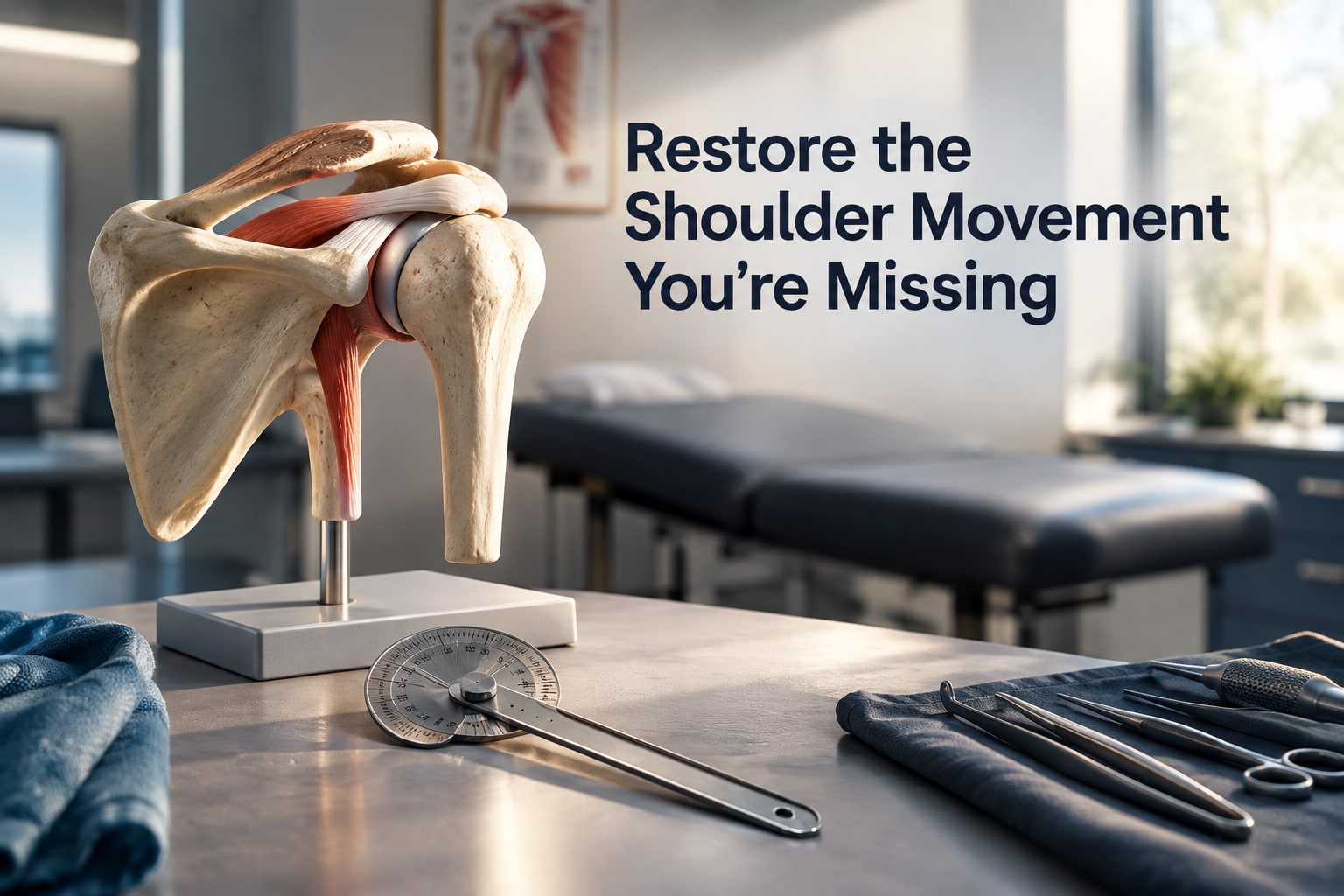
Restricted movement reveals more when active and passive range of motion are compared. Active movement is what you can lift or rotate without help; passive movement is what the examiner can move while you relax.
| Pattern | What it may suggest | Important limitation |
|---|---|---|
| Both active and passive ranges markedly reduced | Adhesive capsulitis, or frozen shoulder | This pattern does not confirm the diagnosis |
| Weak active movement with relatively preserved passive movement | Rotator-cuff dysfunction or pain-related weakness | Strength, nerves, and other causes still require assessment |
| Sharp pain stopping movement | Pain-limited movement | The joint may not be truly stiff |
| A firm, consistent block even when relaxed | True stiffness | Causes include joint disease, scarring, or fracture |
Your account adds useful clues: pain over the front, side, or back of the shoulder; weakness; clicking or crepitus; a slipping sensation suggesting instability; and difficulty reaching overhead, fastening clothing, reaching behind your back, or rotating the arm outward.
The examination also includes your neck, sensation, reflexes, and nerve strength because a pinched neck nerve or peripheral nerve injury can imitate a shoulder disorder. Do not force sharp pain through exercises: aggressive movement can worsen a tendon tear, fracture, or inflamed joint.
“Shoulder surgeon in mahalunge pune for shoulder movement” and “shoulder surgeon in mahalunge” describe an orthopaedic clinician trained to identify the cause of movement loss. That evaluation may lead to physiotherapy or other non-surgical care; surgery is not automatic.
Which Shoulder Conditions Can Reduce Your Reach, Rotation, or Strength?
The failed movement often narrows the possibilities, but it does not prove one diagnosis. A shoulder movement doctor in Mahalunge compares your painful task with your age, injury history, work, sport, and symptom duration.
| Condition | Movement problem it can create | Clues that often accompany it |
|---|---|---|
| Frozen shoulder | Gradually reduced elevation and rotation, including reaching behind the back | Progressive stiffness in several directions |
| Rotator-cuff tear | Weakness lifting the arm, especially after an injury | Difficulty raising the arm despite effort |
| Impingement | Painful overhead reaching | Pain during lifting rather than constant stiffness |
| Osteoarthritis | Declining reach and rotation | Deep pain, stiffness, and crepitus |
| Dislocation or instability | Movement feels unsafe rather than simply stiff | Giving-way or repeated dislocation |
| Labral injury | Catching or painful throwing | Symptoms after sport, traction, or a dislocation |
| Fracture | Sudden inability to use the arm | Severe pain, swelling, or deformity |
| Nerve-related weakness | Poor elevation or shoulder control | Numbness, altered sensation, or weakness beyond the joint |
A fracture or dislocation needs more than a movement assessment. A deformed shoulder, an acutely injured shoulder that cannot move, numbness, or a cold or pale hand requires prompt assessment because circulation and the axillary nerve need checking.
An orthopedic shoulder surgeon in Mahalunge also considers neck disease and peripheral nerve injury, which can imitate shoulder pain. Seek assessment when weakness persists, movement worsens, or the exact cause remains unclear.
What Happens During a Shoulder Movement Consultation in Mahalunge?
A consultation starts with your history: when symptoms began, whether trauma occurred, which tasks are difficult, whether pain wakes you, and what treatment you have tried. Bring prior reports and name the movements you want back, such as reaching overhead, fastening clothing, or rotating your arm outward.
The shoulder movement doctor in Mahalunge then measures active movement, which you perform, and passive movement, which the examiner guides while you relax. Both shoulders are compared; strength testing covers the rotator cuff and other muscles, followed by checks of stability, scapular control, neck movement, sensation, and reflexes.
Imaging follows the examination, not a fixed scan package.
| Test | What it shows | When it is considered |
|---|---|---|
| Plain X-ray | Alignment, fracture, dislocation, joint-space loss, osteophytes, and some cuff-tear arthropathy | Chronic pain, arthritis, suspected fracture, or dislocation |
| Ultrasound | Moving tendons and rotator-cuff tears | Dynamic tendon symptoms or a suspected cuff tear |
| MRI | Tendons, labrum, cartilage, bone marrow, and other soft tissues | When those findings could change treatment |
A normal X-ray does not rule out a tendon or labral problem, but advanced imaging is not automatically needed. Dr Aniruddha Deshmukh-Orthopedic Doctor, Joint Replacement & Arthroscopy Surgeon in Hinjewadi, Pune can help patients discuss examination findings, the appropriate imaging choice, and realistic movement goals for shoulder joint treatment in Mahalunge.
Related service
Shoulder and Elbow Pain Treatment Shoulder and Elbow Pain Treatment in Mahalunge, Pune Dr. Aniruddha Deshmukh is a trusted Fracture and Trauma Care Specialist in Mahalunge, Sus, Pashan and Pune, providing comprehensive orthopedic care... View service → |
How Is Treatment Chosen to Restore a Specific Shoulder Movement?
Treatment follows the diagnosis, severity, functional demand, and response to initial care. Activity modification and pain relief can reduce irritation, while supervised physiotherapy rebuilds mobility, rotator-cuff strength, and scapular control. The target might be lifting above shoulder height, reaching behind your back, rotating outward, returning to work, or resuming sport.
- Frozen shoulder usually needs gradual stretching and rehabilitation, not immediate surgery. A corticosteroid injection can help selected patients move with less pain. Manipulation under anaesthesia or arthroscopic capsular release is reserved for persistent stiffness that limits function despite less-invasive care.
- A rotator-cuff tear may improve with rehabilitation. An acute traumatic tear, persistent disabling weakness, or failure of appropriate rehabilitation can lead to a repair discussion.
- Arthroscopy is a technique, not a diagnosis. It may treat selected cuff, labral, loose-body, impingement, or stiff-shoulder problems, but it is not a universal answer for degenerative pain without a correctable lesion.
- Instability may improve with strengthening and proprioception training. Recurrent dislocation or a structural labral or bone injury may require stabilisation.
- Fracture care ranges from sling use and rehabilitation to fixation or replacement, depending on displacement and joint involvement.
An orthopedic shoulder surgeon in Mahalunge matches the intervention to the movement you need, rather than treating an image alone. Shoulder joint treatment in Mahalunge should include a clear explanation of the working diagnosis, nonoperative options, expected recovery, and the risks of each procedure.
When Do Shoulder Replacement or Surgery Make Sense for Movement Loss?
Shoulder replacement makes sense when advanced osteoarthritis, inflammatory arthritis, a complex fracture, or cuff-tear arthropathy causes persistent pain and functional loss after appropriate nonoperative care. Anatomic replacement relies on a functioning rotator cuff. Reverse replacement changes the mechanics so the deltoid can elevate the arm when the cuff is irreparably deficient.
A reverse replacement is not a return to a normal shoulder. Risks include infection, instability or dislocation, fracture, nerve injury, loosening, and limited rotation. Implant choice depends on cuff status, bone quality, fracture pattern, and your movement goals.
Rehabilitation determines whether the operation protects or threatens your result:
- Repaired tendons need biological healing, so protected passive movement generally comes before active strengthening.
- Follow the lifting limits; forceful activity too early can endanger a tendon repair or fracture fixation.
- Do not keep the shoulder immobilised longer than instructed, because excessive protection can worsen stiffness.
- Expect gradual gains rather than immediate normal movement. The achievable result might be pain-free elevation, but rotation or reaching behind your back can remain limited.
Searching for a shoulder surgeon in Mahalunge Pune for shoulder movement should lead to a clear decision, not an automatic operation. Ask for the working diagnosis, nonoperative alternatives, expected rehabilitation duration, achievable movement, and specific risks.
A second opinion from a shoulder surgeon in Mahalunge is reasonable when the proposed procedure is major or the diagnosis remains uncertain.
Frequently asked questions
What does restricted shoulder movement reveal about the problem?
Comparing active movement with passive movement helps distinguish weakness from joint stiffness. Limited active movement with better passive movement points toward tendon, muscle, or nerve problems. Limited active and passive movement suggests stiffness, arthritis, or another joint restriction.
Which shoulder conditions can reduce reach, rotation, or strength?
Rotator cuff tears, frozen shoulder, shoulder arthritis, dislocation-related damage, fractures, tendon inflammation, and nerve problems can reduce reach, rotation, or strength.
What happens during a shoulder movement consultation in Mahalunge?
The clinician reviews your pain, injury history, and daily limitations, then measures active and passive range of motion, strength, stability, and tenderness. X-rays or scans may be recommended when the examination suggests structural damage.
How is treatment chosen to restore a specific shoulder movement?
Treatment depends on the movement lost, the cause, symptom duration, examination findings, and scan results. Options include activity changes, pain relief, physiotherapy, injections, arthroscopy, or other surgery when non-operative care is insufficient.
When do shoulder replacement or surgery make sense for movement loss?
Surgery is considered when a repairable tear, fracture, instability, or other structural problem continues to limit function after appropriate non-surgical care. Shoulder replacement is considered for severe joint damage, persistent pain, and major loss of useful movement.