The right surgeon depends on the operation you may actually need, not on a broad label such as “orthopedic specialist” or a promise about a particular technique. Use your diagnosis, the surgeon’s procedure-specific experience, verified credentials, hospital capability, complication data and follow-up plan to build a shortlist and decide whether surgery is justified.
Key takeaways
- Match the surgeon’s expertise to your diagnosis, not the body part alone.
- Get a second opinion before treating pain as an automatic reason for surgery.
- Ask for procedure-specific training, case volume and verified registration details.
- Confirm hospital facilities, rehabilitation steps and follow-up access before booking surgery.
Match the diagnosis to the right specialist and operation
The diagnosis, not the label “shoulder surgeon,” should determine who treats you and which operation is considered. Hip pain from osteoarthritis, a fracture, or a pinched nerve needs a different assessment from shoulder pain caused by a tendon tear or neck disease.
| Problem or finding | Best-matched specialist | Operation or treatment discussed |
|---|---|---|
| Advanced hip osteoarthritis with pain and disability | Hip replacement surgeon | Primary total hip replacement; compare approaches and their risks |
| Painful or failed previous hip replacement | Revision hip replacement surgeon | Revision surgery after checking loosening, infection, fracture, or instability |
| Shoulder osteoarthritis with an intact rotator cuff | Shoulder-and-elbow specialist | Anatomic shoulder arthroplasty when non-surgical care no longer works |
| Shoulder arthritis with an irreparable cuff tear | Shoulder-and-elbow specialist | Reverse shoulder arthroplasty after confirming cuff deficiency |
| Rotator-cuff tear, labral injury, or instability | Shoulder surgeon with arthroscopy experience | Arthroscopic repair or stabilisation when examination and imaging match |
| Hip fracture or shoulder fracture | Orthopedic trauma surgeon | Fixation or replacement based on fracture pattern, bone quality, and function |
| Stiff, painful shoulder without a structural tear | Shoulder surgeon or non-operative specialist | Physiotherapy, injection, or treatment for adhesive capsulitis before surgery |
| Shoulder pain with numbness or neck movement symptoms | Spine or nerve specialist | Cervical evaluation rather than shoulder surgery |
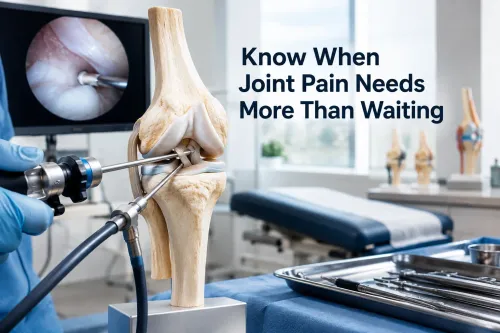
An arthroscopy surgeon definition is a surgeon trained to inspect and repair joints through small portals; that title alone does not prove expertise in hip replacement or shoulder arthroscopy. Ask for annual numbers for your exact procedure, not total orthopedic operations. Verify registration through the Indian Medical Register or the relevant state medical council.
Decide whether surgery is the next step
Consider surgery when pain and loss of function remain substantial after an appropriate non-surgical plan, not because an X-ray looks abnormal. Hip replacement indications combine your symptoms, examination findings and imaging; an abnormal scan without disabling symptoms is not enough.
1. For hip osteoarthritis treatment, try physiotherapy, pain medicines, injections, activity changes and weight management for hip pain before choosing replacement. Reconsider when pain disrupts sleep, walking, work or basic tasks despite these measures, and the surgeon explains what function you can realistically regain.
2. Choose shoulder surgery only after identifying the structure causing the problem. Osteoarthritis, a rotator-cuff tear, frozen shoulder, instability, fracture and a pinched cervical nerve can feel similar but need different treatment.
Surgery becomes more reasonable when targeted non-surgical care fails, a repairable tear causes persistent weakness, instability repeatedly dislocates the joint, or a fracture requires fixation.
3. Ask what happens if you wait, how long you should continue physiotherapy, and what improvement is realistic. Shoulder replacement and rotator-cuff repair often require months for strength and motion to return, so rapid pain relief alone is a poor reason to operate.
4. Before agreeing, confirm the facility can provide anaesthesia, manage blood loss or suspected infection, arrange prompt imaging and physiotherapy, and assess urgent problems outside office hours. Get clear restrictions for driving and lifting, plus the specific symptoms that require immediate help.
Compare procedure-specific training, volume and verified credentials
Treat each operation as a separate skill. Ask about training and annual volume for primary total hip replacement, revision hip replacement, shoulder arthroplasty, rotator-cuff repair, instability surgery or fracture fixation—the procedure you may actually need. A surgeon who performs many knee replacements is not automatically a high-volume hip or shoulder specialist.
- Request the surgeon’s medical registration number, then verify the name and current status in the Indian Medical Register or Maharashtra Medical Council. A degree, website profile or hospital advertisement does not prove current registration or fellowship training.
- Ask where the surgeon completed orthopaedic residency and any fellowship in hip replacement, shoulder and elbow surgery, arthroplasty or sports injury care.
- Ask for the last 12 months’ procedure count, including the exact operation, revisions and emergency cases. Request complication and readmission figures, not only success stories.
- Confirm hospital privileges, anaesthesia support, infection management, blood-loss protocols, imaging, physiotherapy and after-hours postoperative assessment.
| Evidence to compare | What it confirms | Warning sign |
|---|---|---|
| Procedure-specific volume | Repeated experience with your operation | Only total orthopaedic or knee numbers |
| Fellowship and operative training | Focused education in the relevant specialty | Vague claims without institution or dates |
| Registration lookup | Legal identity and current practice status | Missing or unverifiable registration |
| Hospital affiliation and outcomes | Access to trained teams and measurable results | No complication data or follow-up pathway |
For hip surgery, ask whether the surgeon performs both primary and revision replacements. For shoulder surgery, confirm experience with anatomic and reverse shoulder replacement, cuff repair and instability procedures; these are not interchangeable skills. References from patients with a comparable diagnosis add context, but they do not replace records or registration checks.
Ask what the operation involves and how results are tracked
Before agreeing to hip or shoulder surgery, ask the surgeon to explain the operation, its realistic benefit and how success will be measured. Confirm that the recommendation reflects your symptoms, examination and imaging—not an abnormal X-ray or MRI alone—and ask which non-surgical option remains.
1. Which exact procedure do you recommend: primary total hip replacement, shoulder arthroplasty, rotator-cuff repair, instability surgery or fracture fixation? For hip replacement, why this hip replacement surgical approach, and why cemented uncemented hybrid fixation for my age, bone quality, fracture risk and implant design?
2. What could change during surgery? With shoulder arthroscopy, ask what happens if the surgeon finds a different lesion or an unrepairable tear. Include these rotator cuff repair questions: Is the tear repairable, and how do its size, muscle atrophy and fatty degeneration affect healing?
3. What restrictions will apply to walking, driving, lifting, work and sport? Ask how long physiotherapy will last and what level of movement, strength and pain relief is realistic. Shoulder strength can take months to recover.
4. How will you track results? Request baseline and follow-up scores, such as the Oxford Hip Score or HOOS Jr for hip surgery and the Constant-Murley or ASES score for shoulder surgery. Ask for infection, dislocation, stiffness, weakness, re-tear and revision rates, plus the specific symptoms that require urgent help.
Test the local hospital, recovery and follow-up plan
Compare more than the surgeon’s credentials: test whether the hospital can support the operation and the difficult days afterward. Confirm hospital privileges Mahalunge patients can use, who provides anaesthesia, how blood loss is managed, where suspected infection is assessed, and which service handles urgent problems outside office hours.
| Check | Strong plan | Warning sign |
|---|---|---|
| Hospital support | On-site imaging, infection assessment, emergency review and clear after-hours contact | You are told to visit the clinic for every problem |
| Anaesthesia and blood-loss planning | A named anaesthetist explains your risk, medicines and transfusion policy | The surgeon gives a generic answer |
| Recovery | Written weight-bearing, sling, wound-care and activity instructions | Recovery depends on verbal advice alone |
| Physiotherapy | postoperative physiotherapy Pune access is arranged before discharge | You must find a therapist after surgery |
| Outcomes | complication reporting and revision figures are discussed by operation | Only satisfaction scores or total operation numbers are offered |
Ask how hip patients receive an individual venous-thromboembolism plan, including drug choice and duration based on bleeding risk, mobility and the operation. For hip replacement, ask why a particular surgical approach fits you and how the surgeon weighs dislocation, fracture, nerve injury and wound risks.
Before choosing, request:
- The hospital’s direct emergency number and the location for an after-hours review.
- The name of the physiotherapist and the first follow-up date.
- A written plan for infection, dislocation, fracture, clot symptoms and readmission.
When comparing Dr Aniruddha Deshmukh-Orthopedic Doctor, Joint Replacement & Arthroscopy Surgeon in Hinjewadi, Pune, apply this same hospital-and-follow-up checklist rather than judging the consultation alone.
Related services
Hip Replacement Surgeon Hip Replacement Surgeon in Mahalunge, Pune Dr. Aniruddha Deshmukh – Trusted Hip Replacement Surgeon in Mahalunge, Sus, Pashan and Pune. Dr. View service → |
Joint Replacement Surgeon Joint Replacement Surgeon in Mahalunge, Pune Dr. Aniruddha Deshmukh – Leading Joint Replacement Surgeon in Mahalunge, Sus, Pashan and Pune. View service → |
Frequently asked questions
How do I match my diagnosis to the right hip or shoulder surgeon?
Start with the diagnosis, because osteoarthritis, fractures, tendon tears and neck-related pain require different assessments and operations.
How can I decide whether surgery is the next step?
Ask whether the diagnosis is confirmed, which nonsurgical treatments remain, what happens if you wait, and why surgery offers a better expected result.
What credentials should I compare between surgeons?
Check medical registration, orthopedic qualifications, procedure-specific training, experience with the proposed operation and verified case volume.
What should I ask about the operation and its results?
Ask about the surgical steps, implant or repair method, risks, recovery timeline, restrictions, outcome measures and how results are tracked.
What should I check about the hospital and follow-up plan in Mahalunge?
Confirm the hospital’s operating facilities, anesthesia and emergency support, physiotherapy access, discharge process and how you will contact the surgeon after surgery.
Related service
Hip Replacement Surgeon Hip Replacement Surgeon in Hinjewadi, Pune Dr. Aniruddha Deshmukh – Trusted Hip Replacement Surgeon in Hinjewadi, Marunji and Pune. Dr. View service → |